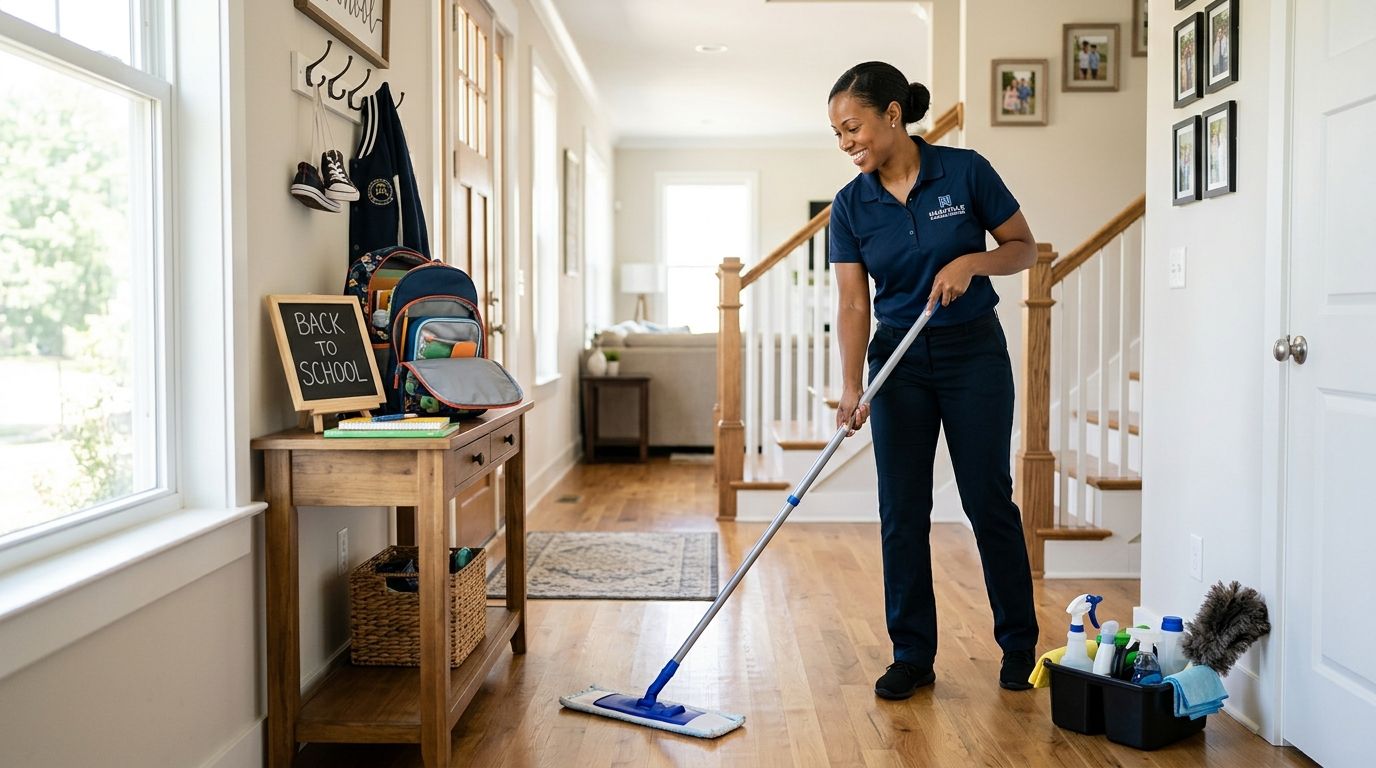
Back-to-school in Nashville means carpool lines, forgotten cleats, and a house that goes from tidy to trashed in about six days flat. This guide ranks the cleaning plans that actually hold up once the school year hits, so you can pick one before week two wrecks you.
- Weekly recurring cleaning wins for large families juggling multiple school schedules in 2026.
- Bi-weekly cleaning fits dual-income households best when both parents work full-time.
- A homeschooling-household plan handles the extra daytime mess that traditional schedules miss.
- House cleaning back to school Nashville searches spike in August, and the right frequency matters more than the price tag.
- Porch and Parlor Cleaning books all of these plans online through its Nashville scheduling site.
Why this matters
August flips a house upside down. Backpacks dump by the door, lunchboxes pile in the sink, and the quiet cleaning routine you had all summer gets steamrolled by 7 a.m. bus pickups. Most Nashville families don't need a fancier cleaner in 2026 — they need a different schedule.
Before you book anything, it helps to know how to vet a house cleaning company so you're not guessing at what's actually included. Once you know what to look for, the plan you pick matters more than the brand name on the invoice.
What makes the best back-to-school cleaning plan
- Frequency that matches your household's mess rate, not a generic default
- Flexibility around school hours — cleaners who can work while kids are out
- Consistent crew so nobody has to re-explain the house every visit
- Clear scope for kid zones: playrooms, mudrooms, bathrooms with three toothbrushes fighting for counter space
- Easy scheduling changes for early dismissals, sick days, and holiday breaks
- No surprise line items on the invoice after a busy month
At a glance: back-to-school cleaning plans ranked
| Plan | Best for | Standout feature | Key limitation |
|---|---|---|---|
| Weekly recurring cleaning | Large families with multiple school-age kids | Keeps up with daily mess before it compounds | Highest visit frequency to schedule around |
| Bi-weekly cleaning | Dual-income households | Balances cost against upkeep | Mess can build mid-cycle with active kids |
| Homeschooling household plan | Families schooling from home | Covers daytime wear traditional schedules miss | Needs a cleaner comfortable working around lesson time |
| Subscription-style recurring setup | Families locking in a schedule for the semester | Removes the monthly rebooking hassle | Less flexible if your routine is still shifting |
| Work-from-home parent plan | Parents now home solo during school hours | Cleaning happens while the house is actually empty of kids | Only works if your own schedule is predictable |
1. Weekly recurring cleaning: best for large families with multiple school-age kids
If you've got three kids in three different school buildings, weekly is the only frequency that keeps pace. Backpacks, sports gear, and snack wrappers accumulate fast when everyone's schedule is different, and a once-a-month visit just can't catch up.
Weekly maid service for large families pros:
- Keeps kitchens and bathrooms from ever hitting crisis mode
- Matches how fast mess actually accumulates with multiple kids
- Easier to spot small issues (a sticky floor, a musty towel) before they're big ones
Weekly recurring cleaning cons:
- Costs more over a month than lower-frequency plans
- Requires a consistent day/time slot that works around after-school activities
Best for: Households with three or more kids across different schools. Verdict: Buy if your house turns over fast — this is the plan that actually keeps up.
2. Bi-weekly cleaning: best for dual-income households
When both parents are working full days and managing drop-off and pickup, bi-weekly cleaning hits the sweet spot between cost and control. It's the most common plan Nashville dual-income families land on once the school year starts.
House cleaning for dual-income households pros:
- Lower total visits than weekly, easier on a tight household budget
- Still frequent enough to prevent deep-clean-level buildup
- Predictable rhythm that's easy to plan around
Bi-weekly cleaning cons:
- Bathrooms and kitchens can look rough by day 10 with active kids
- Doesn't flex well around unplanned school closures
Best for: Two working parents with school-age kids and a fixed calendar. Verdict: Buy — it's the realistic default for most working households.
3. Homeschooling household plan: best for families schooling from home
Homeschooling households wear their floors down differently — art supplies, science experiments, and a kitchen table doubling as a desk all day. Traditional weekday-morning cleaning schedules built around empty houses don't fit here.
House cleaning for homeschooling households pros:
- Built around daytime occupancy instead of assuming an empty house
- Handles craft and project messes that regular schedules don't anticipate
- Crews get comfortable working quietly around active lesson time
Homeschooling plan cons:
- Requires more coordination than a standard empty-house visit
- Fewer providers offer this as a distinct scheduling option
Best for: Families with kids home and learning during the day. Verdict: Buy if your current plan keeps missing the daytime mess.
4. Subscription-style recurring setup: best for families locking in a schedule for the semester
Setting up a recurring plan once at the start of the school year beats rebooking every single month. It's less about a new type of cleaning and more about not having to think about scheduling again until winter break.
Subscription-style recurring setup pros:
- One setup covers the whole semester
- Removes the mental load of monthly rebooking
- Easier to budget when the cadence is locked
Subscription-style recurring setup cons:
- Less room to adjust if your family's routine is still settling in
- Best set up after you've already tested a frequency, not before
Best for: Families who've already found their ideal frequency and want to stop rebooking. Verdict: Wait until you've run a plan for a month or two — then lock it in.
5. Work-from-home parent plan: best for parents now solo during school hours
Once the kids are back in class, a lot of Nashville parents suddenly have an empty house from 8 to 3 for the first time since summer. That window is prime time for a cleaning crew to work without anyone underfoot.
Work-from-home parent plan pros:
- Cleaning happens with zero kid traffic to work around
- Frees up evenings and weekends for actual family time
- Crews can move through the whole house without interruption
Work-from-home parent plan cons:
- Only works if the school-hours window is predictable
- Doesn't help much on early dismissal or snow days
Best for: Parents whose kids are gone most of the school day. Verdict: Buy — it's the easiest window to schedule around.
How this ranking was built
Each plan was scored against the same criteria: how well it matches real mess accumulation, how much scheduling flexibility it allows around school hours, and how consistent the results stay week to week. Weekly and bi-weekly plans rank highest because they map directly to how fast a house gets messy with kids in school — everything else is a variation on that core choice.
Which back-to-school cleaning plan should you choose?
If you've got a big, busy household, weekly recurring cleaning is the safe default for 2026. Two working parents with a fixed routine should start with bi-weekly and adjust from there. Homeschooling families need a plan built around daytime occupancy, not an empty-house assumption. Whatever you land on, set up recurring house cleaning before the semester gets busy — waiting until October means playing catch-up the whole year.
FAQ
What's the best house cleaning schedule for back to school in Nashville?
Weekly cleaning works best for large families with multiple kids in school, while bi-weekly fits most dual-income households. The right cadence depends on how fast your specific house gets messy, not a one-size-fits-all rule.
Is bi-weekly cleaning enough once school starts?
For most two-income households, yes — bi-weekly keeps kitchens and bathrooms from spiraling. Families with three or more active kids often find bi-weekly leaves too much buildup by day 10.
How much does house cleaning cost in Nashville in 2026?
Pricing varies by home size, frequency, and scope, so it's best to get a current quote directly rather than relying on a fixed number. Recurring plans generally cost less per visit than one-off deep cleans.
Should homeschooling families use a different cleaning plan?
Yes — homeschooling households wear down floors and common areas differently since kids are home all day. A plan built around daytime occupancy handles that better than a traditional empty-house schedule.
When should I set up recurring cleaning for the school year?
Set it up before the first week of school, not after things get chaotic. Locking in a schedule early means one less thing to manage once homework and activities start stacking up.
Can I switch cleaning frequency mid-semester?
Most recurring plans allow frequency changes, so you can move from weekly to bi-weekly or back as your routine shifts. It's worth testing a frequency for a month before locking in a longer-term plan.
What's the difference between weekly and bi-weekly cleaning for families with kids?
Weekly cleaning keeps pace with daily mess from multiple kids' schedules, while bi-weekly stretches further between visits and costs less overall. Larger, busier households tend to outgrow bi-weekly first.
Does Porch and Parlor Cleaning offer recurring plans for back to school?
Porch and Parlor Cleaning books recurring house cleaning plans online for Nashville homeowners, including weekly and bi-weekly options. Scheduling runs through its online booking site so you can set a cadence and adjust it as needed.
One last thing
A good workman never blames his tools, and the same goes for a cleaning schedule — the problem usually isn't the cleaner, it's the frequency you picked back in June that no longer fits an August full of backpacks and bus schedules. The families who make it through the school year without a Sunday-night scramble are the ones who matched their plan to their actual mess, not their ideal one. Recheck your frequency every semester, not just once a year.