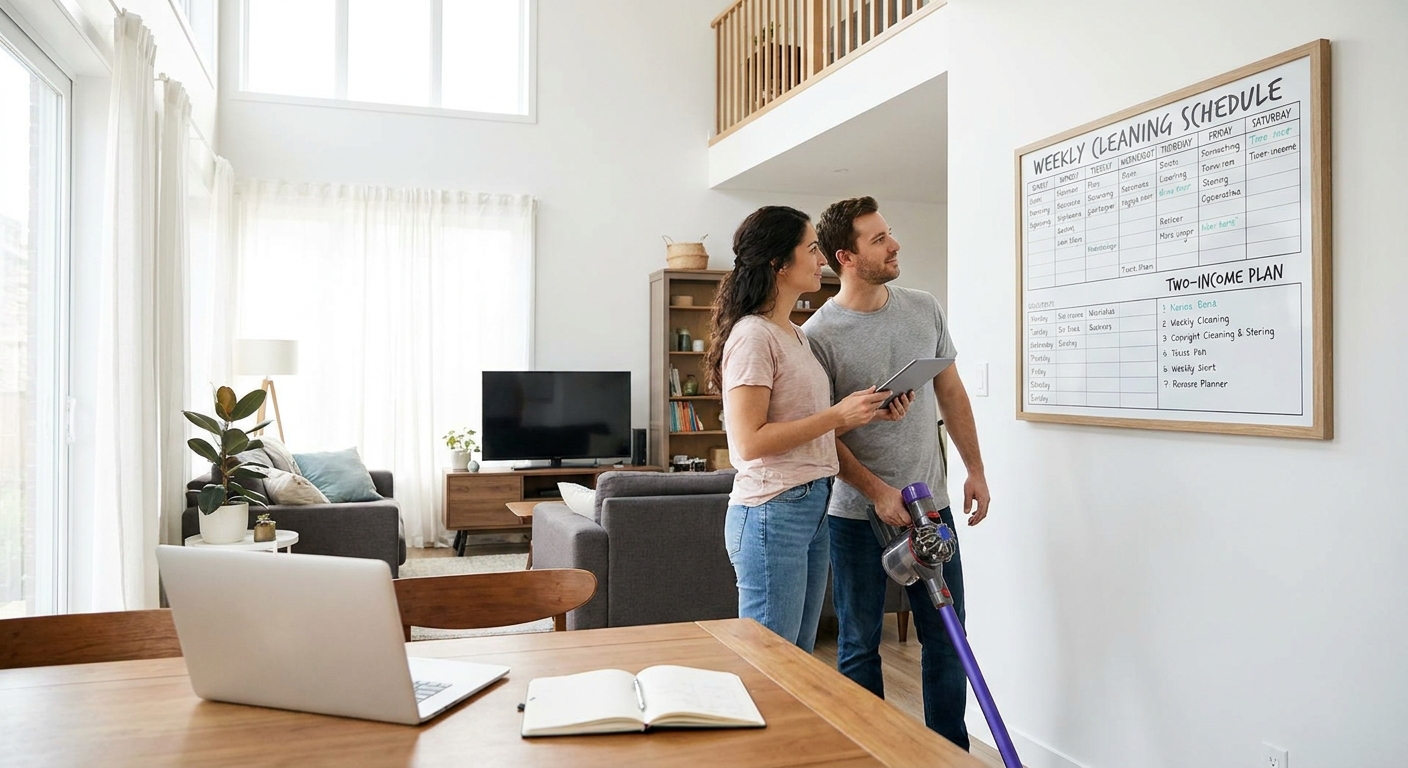
Two incomes and one dirty kitchen counter — sound familiar? The best recurring cleaning plan for two-income households in Nashville comes down to matching frequency to your actual mess-making rate, not picking whatever sounds impressive.
- Bi-weekly cleaning is the best recurring cleaning plan for most two-income households in 2026 — buy it.
- Weekly service wins if you have kids, pets, or entertain often — the extra visits pay for themselves in saved weekends.
- Monthly-only plans are a Skip for dual-income homes — 30 days between visits lets grime set in tile grout and bathroom seals.
- Custom rotating plans (kitchen/baths every visit, deep zones on rotation) suit condo and townhome dwellers with tighter square footage.
- Porch and Parlor Cleaning books all of these frequencies online through its Nashville scheduling system.
Why this matters
Two working schedules mean cleaning gets squeezed into whatever's left of Saturday — and usually loses. The frequency you pick isn't just a scheduling question, it's a budget question and a sanity question rolled into one.
Pick too infrequent a plan and you'll spend your "time off" scrubbing a stovetop anyway, which defeats the entire point of hiring help. Pick too frequent a plan and you're paying for visits where the crew is basically just wiping down counters that were already clean. The goal in 2026 is matching the plan to your household's actual dirt-accumulation rate, not to what sounds responsible.
A cleaning plan built for dual-income households accounts for the fact that nobody's home during the week to notice buildup — which changes what "clean enough" looks like by the time Friday rolls around.
How this list was ranked
This ranking weighs four things: how well each frequency matches a two-income household's weekly mess load, cost efficiency per visit, flexibility to adjust as life changes (new baby, new pet, in-laws visiting), and how well it holds up in homes with kids or pets versus homes without. Plans that only work for one household type get flagged as such rather than ranked as universal winners. As they say, a good workman never blames his tools — but the wrong cleaning frequency will make even a great cleaning crew look like they're falling short.
The ranked plans
1. Bi-weekly cleaning — the default that works for most
Every-other-week service is the plan most dual-income households land on, and for good reason. It hits the sweet spot: kitchens and bathrooms get reset before grime becomes a project, and you're not paying for redundant visits.
At 26 visits a year, bi-weekly service covers roughly 730 days of household wear in half the appointments a weekly plan would need — the math works for most two-adult, no-kids-under-five households. Nashville townhomes with smaller footprints see this play out especially well, since less square footage means less time between visits actually matters. Check the bi-weekly cleaning option for Nashville townhomes if your unit is under 2,000 square feet. Verdict: Buy — this is the starting point for almost every dual-income household in 2026.
2. Weekly cleaning — the plan for chaos-prone households
Kids, dogs, or a home office that doubles as a snack station all push the math toward weekly visits. Seven days is a short enough window that bathrooms and kitchens never get past "lightly used" before the next appointment.
Households running weekly service report the biggest quality-of-life jump specifically because weekends stop being catch-up days. If your household includes more than two people generating daily mess, look at a weekly maid service built for larger, busier families rather than trying to stretch a bi-weekly plan to cover it. Verdict: Buy — worth the extra visits when the household size or activity level justifies it.
3. Monthly deep clean only — the budget stretch that backfires
A once-a-month deep clean sounds efficient on paper. In practice, 30 days is enough time for shower grout to need real scrubbing again, for dust to resettle twice over, and for the "deep clean" to really just be a "catch-up clean" every visit.
This plan works for guest rooms, seasonal homes, or spaces that genuinely sit unused most of the month. It does not work for a primary residence with two working adults generating daily kitchen and bathroom use. Verdict: Skip for dual-income households unless it's paired with your own maintenance routine between visits.
4. Custom rotating plan — the negotiator's pick
This is a hybrid: kitchen and bathrooms get attention every visit, while bedrooms, baseboards, and less-trafficked rooms rotate on a longer cycle. It's a smart middle ground for condo and apartment owners who don't need full-home attention every time but do need the high-touch rooms handled consistently.
Custom plans take a bit more setup conversation upfront, since the crew needs to know your rotation priorities. Households figuring out the right cadence should start with a look at the best cleaning frequency guide for busy Nashville families before locking in a rotation. Verdict: Consider — best for households with uneven room usage.
5. One-time deep clean, no recurring plan — the gamble
Skipping recurring service entirely and booking a deep clean whenever things get bad enough is technically an option. It's also the most expensive option per hour of cleanliness you actually get, since every visit starts from scratch instead of maintaining a baseline.
Two-income households that try this usually end up calling back within six to eight weeks anyway, at which point they've paid deep-clean rates twice instead of maintenance rates four times. Verdict: Skip — the math never favors this for a primary residence in 2026.
Comparison table
| Plan | Visits per year | Best for | Verdict |
|---|---|---|---|
| Bi-weekly | 26 | Standard dual-income households, townhomes | Buy |
| Weekly | 52 | Kids, pets, high-traffic homes | Buy |
| Monthly deep clean | 12 | Guest spaces, low-use rooms only | Skip |
| Custom rotating | Varies | Condos, apartments, uneven room use | Consider |
| One-time as-needed | Varies | Nobody with a primary residence | Skip |
How to book the right plan
- Start with bi-weekly and adjust after two visits — most households know within a month whether the cadence is too loose or too tight.
- Tell the booking team about pets and kids upfront; it changes the room-by-room approach even within the same frequency.
- If you work from home, mention it when booking — a house cleaning plan for work-from-home professionals schedules around your calls instead of around them.
Book your recurring cleaning plan
Set up bi-weekly, weekly, or custom service online in a few minutes.
FAQ
What's the best recurring cleaning plan for two-income households in 2026?
Bi-weekly cleaning is the best recurring plan for most two-income households in 2026, covering 26 visits a year without letting grime build up between appointments. Households with kids or pets often need weekly service instead.
Is bi-weekly cleaning enough for a busy household?
Bi-weekly cleaning is enough for most two-adult households without kids under five or multiple pets. Add a weekly plan if your home generates daily mess in the kitchen and bathrooms.
How much does a recurring cleaning plan cost for a dual-income home?
Cost varies by home size, frequency, and add-ons, so check current rates through the online booking system for an exact quote. Recurring plans generally cost less per visit than one-time deep cleans booked repeatedly.
Should we do weekly or bi-weekly cleaning with kids and pets?
Weekly cleaning is the better fit once kids or pets are in the mix, since seven days keeps bathrooms and floors from getting past a light mess. Bi-weekly can still work if the household is otherwise low-traffic.
Can dual-income households customize which rooms get cleaned?
Yes, custom rotating plans let you prioritize kitchens and bathrooms every visit while rotating bedrooms and less-used rooms on a longer cycle. This works well for condos and apartments with uneven room usage.
Is monthly cleaning ever enough for a working couple?
Monthly cleaning only works for a primary residence if it's paired with your own light maintenance between visits. On its own, 30 days is long enough for grout and dust to need real scrubbing again.
How do I switch cleaning frequency once I start a plan?
Most recurring plans can be adjusted after your first two visits once you know if the cadence is too loose or too tight. Contact the booking team directly to change frequency without canceling the whole plan.
Do recurring cleaning plans include deep cleaning tasks?
Recurring plans typically cover standard maintenance cleaning, with deep cleaning tasks handled as an add-on or separate service. Ask about rotating deep-clean tasks into a custom plan if you want both covered.
One last thing
The households that switch frequencies mid-year almost always go from monthly to bi-weekly, never the other direction — once you feel what a maintained house feels like on a Tuesday, going back to a once-a-month reset feels like a step backward. If you're on the fence in 2026, start with bi-weekly and downgrade only if you genuinely don't need it.