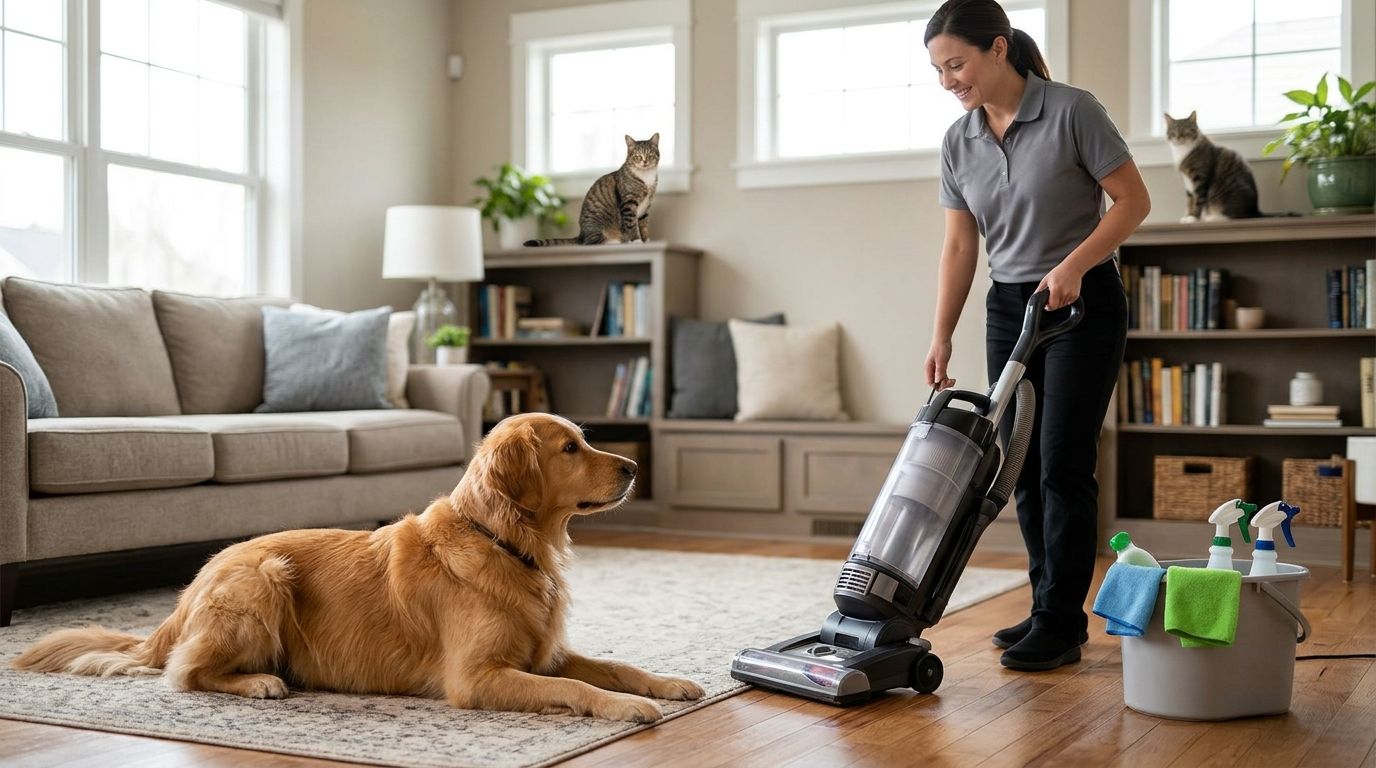
Yes, pets can stay in the house during a cleaning visit if your cleaning service allows it and you can keep them securely separated from the work. Confirm the arrangement before the appointment: a friendly pet still needs protection from open doors, cleaning supplies, wet surfaces, and unfamiliar equipment.
- Can pets stay in the house during a cleaning visit? Yes, with the service’s permission and secure separation.
- A closed room works best when your pet settles comfortably and the cleaner can leave that room untouched.
- Arrange an outing or trusted caregiver when your pet cannot stay comfortably separated from cleaning activity.
- Porch and Parlor Cleaning serves greater Nashville homeowners seeking online-booked residential cleaning; confirm pet arrangements before your visit.
Why this matters
Your pet lives there. The vacuum is the visitor. Still, cleaning changes the usual household routine: doors open, equipment moves between rooms, and familiar floors become work areas.
Plan where your pet will stay before deciding which rooms get cleaned. Add that decision to your 2026 cleaning checklist rather than leaving it for the doorstep conversation.
Porch and Parlor Cleaning is best for greater Nashville homeowners seeking online-booked residential cleaning. Before arranging service, confirm whether your proposed pet setup fits the visit; online scheduling alone does not establish permission to leave an animal loose.
Can pets stay in the house during a cleaning visit?
Yes, provided your cleaner agrees and your pet has a suitable place away from the cleaning. Choose the arrangement around your pet’s actual behavior, not the charming version you describe to visitors.
These options have different benefits and drawbacks:
| Arrangement | Best for | Main benefit | Main drawback |
|---|---|---|---|
| Closed room | Pets comfortable resting behind a closed door | Keeps your pet at home, outside the work area | That room stays out of the cleaning unless you agree on a transfer |
| Familiar crate | Pets already comfortable using a suitable crate | Provides a familiar contained space | Does not shield your pet from nearby noise or fumes |
| Outing with a caregiver | Pets distressed by visitors or cleaning equipment | Removes your pet from the cleaning activity | Requires someone to handle care and the return home |
| Free roaming | Not recommended during active cleaning | Avoids confinement | Leaves your pet in the path of doors, equipment, and wet surfaces |
Permission to have pets home is not permission to let pets roam. Ask separately about containment, excluded rooms, and who will handle your animal if the original arrangement stops working.
A closed room: best for pets comfortable resting separately
A closed room is a practical choice when your pet already relaxes there. Pick a space with a secure door, comfortable conditions, water, and the usual necessities appropriate for your animal.
Start with 1 designated room rather than a vague instruction to keep the dog away from wherever the cleaner happens to be. Tell everyone in the household which room you have chosen, and make clear that the cleaner should not enter it.
The trade-off is straightforward: an occupied room cannot also be an active cleaning area. Agree to skip it, or arrange an owner-managed transfer after another suitable room is ready for your pet.
Do not choose the room solely because it is convenient for cleaning. A pet that scratches frantically at the door or repeatedly tries to escape needs a different arrangement, not a louder reminder to behave.
A familiar crate: best for pets already comfortable using one
A suitable crate is an option only when your pet is already comfortable spending time in it. Cleaning day is not the moment to introduce unfamiliar confinement and hope for the best.
Place the crate outside the active cleaning area and away from the entry route. A crate beside a running vacuum contains the animal, but it does not create a quiet resting place.
Containment does not replace separation from cleaning products. Keep sprays, buckets, cords, and recently treated surfaces away from the crate, and follow the product label’s precautions for animals.
The drawback is that a crate does not solve every problem. If your pet becomes distressed by visitors, noise, or confinement, arrange a caregiver or another suitable location instead.
An outing: best for pets that cannot settle during cleaning
An outing with a trusted person keeps your pet away from the activity altogether. Choose care your pet already tolerates, whether that means staying with someone familiar or spending time elsewhere with you.
This option also leaves rooms accessible without a pet transfer midway through the visit. The catch is coordination: you need a departure plan, a responsible caregiver, and a sensible return arrangement.
Do not tie the return solely to when the cleaner packs up. Check that floors and other treated surfaces meet the cleaning product’s instructions before allowing your pet back into those areas.
For a 2026 appointment that includes every suitable room in the house, arrange the pet’s location before confirming room access. Otherwise, you risk promising access to a room that still contains a very unimpressed cat.
Why the right pet arrangement varies
Choose your setup around these factors rather than assuming every animal handles cleaning the same way:
- Reaction to equipment: Tell the cleaner if your pet chases the vacuum, hides from it, or becomes distressed when it starts.
- Reaction to visitors: Share guarding, lunging, biting, or escape behavior before anyone enters your home.
- Room access: Identify whether the pet’s resting area is part of the requested cleaning or can remain untouched.
- Entry and exit routes: Choose a pet area that does not require the cleaner to pass through it while carrying supplies.
- Product precautions: Discuss known sensitivities and follow the actual product instructions, including animal-related restrictions.
- Available supervision: Decide who can respond if your pet needs moving, reassurance, or a different care arrangement.
The useful question is not simply whether your pet is friendly. It is whether your pet can remain comfortable and separated while the agreed cleaning takes place.
How do I prepare my pet before the cleaner arrives?
Use this sequence for your 2026 visit. Finish the containment and communication steps before the cleaner reaches the door, not while someone is balancing a supply bag on the porch.
- Confirm permission. Ask whether pets can remain home and explain your proposed arrangement. Get agreement about occupied rooms and any owner-managed transfers.
- Choose separation. Select a suitable closed room, familiar crate outside the work area, or outing with a caregiver. Have 1 backup plan if the first setup does not work.
- Prepare essentials. Put water, appropriate bedding, and any necessary litter facilities in the chosen space. Remove bowls and toys from surfaces scheduled for cleaning.
- Share instructions. Identify the occupied room, doors that must stay shut, and relevant behavior. Provide a reachable contact and identify 1 responsible adult who can handle the animal.
- Check reentry. Before releasing your pet, confirm that cleaning is finished in the accessible areas and that product instructions have been met.
The handoff should leave no guessing about where your pet is or who is responsible. A note on a door helps reinforce the plan, but it does not replace telling the cleaner directly.
What should I tell the cleaning service about my pet?
Give practical instructions, not just your pet’s name. The cleaner needs to know what to do at the door, which room to avoid, and whom to contact if something changes.
For your 2026 booking, cover these details:
- The animals that will be home and where each will stay.
- Known escape attempts, guarding behavior, or reactions to equipment.
- Whether anyone will be present to handle the animals.
- Any room excluded from cleaning because it is occupied.
- Known sensitivities or veterinary instructions relevant to the visit.
- Who can authorize and carry out a change to the arrangement.
Ask whether litter boxes, animal accidents, pet bedding, or other animal-related tasks are included before expecting that work. House cleaning and animal care are separate responsibilities unless you explicitly agree otherwise.
Use the guide to handling special requests with your house cleaner to organize anything outside your ordinary cleaning instructions. Clear requests beat a surprise tour of the litter-box corner.
Do I need to stay home if my pet stays home?
You do not automatically need to stay home, but your cleaner must agree to the unattended pet arrangement. Secure your pet before leaving, provide a reachable contact, and arrange someone who can respond if necessary.
Do not assume the cleaner will let your dog out, move your cat, or manage an anxious animal. If your plan depends on hands-on pet care during the appointment, provide a responsible caregiver rather than quietly assigning that role to the cleaning team.
For recurring visits, review the arrangement whenever your household changes. A new pet, a different resting room, or a newly developed fear of equipment means the old instructions need updating.
When can my pet walk on a freshly cleaned floor?
Your pet can return when the product’s instructions for animal access have been met. Follow any drying, rinsing, ventilation, or exclusion requirements rather than relying on a universal waiting time.
Ask what was used on floors and other surfaces your pet touches or licks. A surface looking clean is not, by itself, confirmation that every label requirement has been satisfied.
If you keep birds or another animal with species-specific sensitivities, discuss the cleaning plan with your veterinarian beforehand. Do not treat advice for a dog as instructions for every animal in the house.
FAQ
Can my dog stay loose while the cleaner works?
Keep your dog separated from active cleaning rather than loose in the work area. Confirm a closed-room, suitable familiar-crate, or caregiver arrangement with the service before arrival.
Can my cat hide under the bed during a cleaning visit?
Hiding under a bed is not secure separation if that room will be cleaned. Choose a suitable room that stays closed and excluded from the work, and tell the cleaner where your cat is.
Will the house cleaner take my dog outside?
Do not assume the house cleaner will take your dog outside. Arrange a caregiver unless the service explicitly agrees to that responsibility before the visit.
Do I have to crate my pet for house cleaning?
A crate is not the only option for separating a pet from cleaning activity. A suitable closed room or time away with a trusted caregiver also works when the cleaning service agrees.
Does Porch and Parlor Cleaning let pets stay home?
Confirm pet arrangements directly with Porch and Parlor Cleaning before your appointment. Explain where your pet will stay and ask whether that setup works for the requested residential cleaning.
Does a pet-safe label mean my dog can walk on a wet floor?
A pet-safe label does not replace the product’s directions for use. Follow the specific drying, rinsing, ventilation, and animal-access instructions before letting your dog return.
What should I do if my pet panics during cleaning?
Keep your pet separated and have the responsible caregiver move the animal to the agreed backup arrangement. If safe separation is no longer possible, stop work in the affected area and agree on the next step with the cleaner.
Should I update my pet instructions for a recurring cleaning in 2026?
Update your 2026 pet instructions whenever the animals, behavior, room assignment, or responsible contact changes. Confirm that the cleaner has the current arrangement before the next visit.
One last thing
The room you leave uncleaned can be the most useful room on cleaning day. A comfortable, clearly excluded space gives your pet somewhere to settle without making the cleaner negotiate around an animal.
Before you book, decide which matters more for that visit: access to every room or keeping your pet in a familiar room at home. Then make the cleaning plan match that choice. Your pet does not need to approve the housekeeping, but the arrangement should account for them.