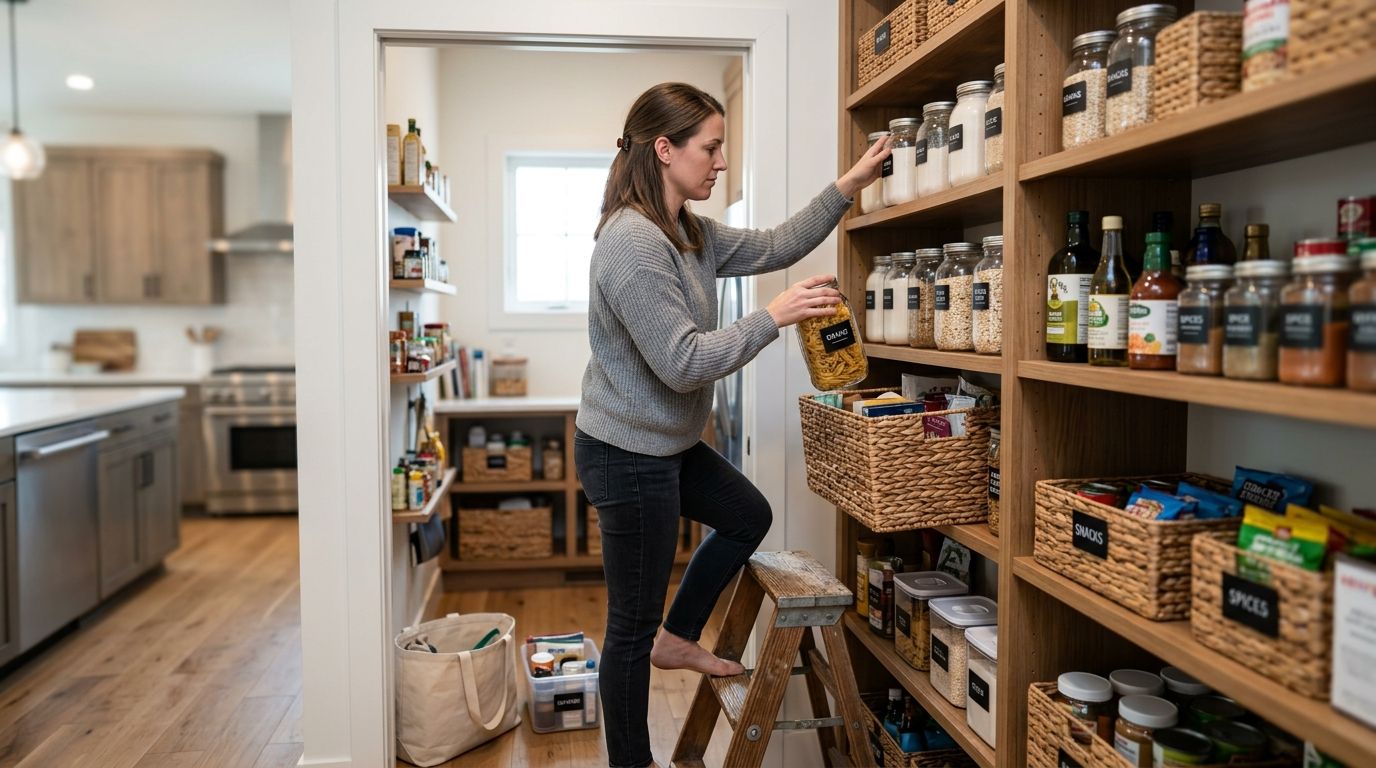
Clear off the shelves, pull expired cans and boxes, and group loose items into bins before your crew arrives — that's the short version of how to prepare pantry before cleaning visit day. Spend eight to ten minutes on this and your cleaner goes straight to wiping shelves, door tracks, and baseboard corners instead of shuffling cereal boxes around for the first ten minutes of the appointment.
- Clear pantry shelves and toss expired food so the crew can reach every surface in 2026.
- Group loose items into bins first: cleaners wipe shelves, they do not reorganize your pantry.
- Sweep or vacuum the walk-in floor beforehand if crumbs and spilled grains are visible.
- Bag or wipe anything sticky so appointment time goes to shelves, not syrup archaeology.
- Prepping a pantry before a cleaning visit takes 8 to 15 minutes and buys you a deeper clean at the same scope.
Why this matters
A cleaning visit is priced by scope, not by how long you spend digging through your own cabinets. When a pantry is packed floor to ceiling, a cleaner has two options: skip the shelves entirely, or spend a chunk of the visit relocating your canned tomatoes before touching a single surface. Neither one gets you the clean you booked.
Pantries get left out of the pre-visit routine because homeowners assume they are off-limits — too personal, too messy, too much of a project. They are not. They are shelves. Shelves just need clear space to get wiped properly, same as a countertop.
This applies whether you book a one-time deep clean or set up recurring service with Porch and Parlor Cleaning across the Nashville area. Ten minutes of prep on your end in 2026 changes a pantry from a skipped room to a properly cleaned one.
How do you prepare a pantry before a cleaning visit?
Here is the order that works, whether you have a true walk-in with four walls of shelving or a single-door closet off the kitchen.
- Start with the bottom two shelves. They collect the most crumbs, spilled grains, and dropped pasta. They are also the easiest shelves for a cleaner to reach and wipe once they are clear, so clearing them first gives you the biggest return on the least effort.
- Check dates and throw things out. Expired boxes, stale spices, rusted lids, swollen cans — trash, not back on the shelf. Most households clear a full shelf of space doing nothing but this step.
- Consolidate open bags. Flour, rice, chips, powdered sugar. Clip them shut or move them into containers so nothing spills while shelves are being lifted and wiped.
- Bin everything sitting on the floor. A crew can vacuum around a labeled bin. They cannot vacuum around a torn bag of dog food and a loose stack of reusable grocery totes.
- Wipe the sticky spots you already know about. Honey, olive oil, and syrup residue set harder the longer they sit. Thirty seconds with a warm cloth beats five minutes of scraping on the day.
- Leave a clear path through the door. No step stool, no shipping boxes, no laundry basket parked in the entrance.
A quick pass through the same prep you would do for a kitchen deep clean covers a lot of this ground, since pantries almost always sit off the kitchen and get the same once-over during a visit.
The 10-minute version
Short on time the morning of your visit? Do three things only: toss what is visibly expired, bag loose floor items, and wipe the one sticky shelf you already know about. That alone is usually enough to turn a partial shelf wipe into a full one.
The 30-minute version
If you have a half hour and a walk-in pantry, add these: pull items off the top shelf so the crew can reach the highest surfaces without moving your stockpile, run a broom across the floor, and group like with like so nothing has to be rearranged twice. This is the version worth doing before a first-time deep clean, because that visit sets the baseline every later appointment maintains.
What a cleaner does versus what you do
The fastest way to avoid disappointment is knowing where the line sits. Pantries are the single most common place homeowners expect organizing and get cleaning instead.
| Task | Who handles it | Why |
|---|---|---|
| Wiping shelf surfaces | Your cleaner | Standard part of a kitchen or pantry clean |
| Wiping door tracks and door faces | Your cleaner | Grease and hand marks build up here fastest |
| Sweeping or vacuuming a walk-in floor | Your cleaner | Included once the floor is clear of loose items |
| Deciding what is expired | You | Nobody throws away your food but you |
| Sorting items into bins or zones | You | Organizing is a separate project from cleaning |
| Emptying and relabeling containers | You | Requires knowing your own system |
| Reaching behind a fully loaded shelf | Nobody, realistically | The items have to come off first |
Verdict: treat the pantry like a countertop, not a closet. Clear the surface, and the crew handles the rest. Leave it loaded, and you get a dusted-around-the-edges result.
“Clear shelves get you a deep clean. Cluttered shelves get you a cleaned-around-the-edges clean.”
Why pantry prep time varies
Not every pantry takes the same ten minutes. A handful of things push that number up or down:
- Walk-in versus closet-style. More shelf linear footage means more surfaces to clear and more to wipe. A four-wall walk-in can hold three times the shelving of a reach-in closet.
- Time since the last real clear-out. A pantry untouched since holiday baking takes noticeably longer than one you tidy monthly.
- Pets in the house. Kibble bags, treat jars, and litter supplies stored in the pantry add crumbs and, sometimes, pests.
- Bulk shopping habits. Warehouse-club stockpiling means more items to consolidate before shelves are even visible.
- Wire shelving versus solid wood. Wire sheds less dust but needs items fully lifted clear so a cloth can get between the slats.
- Whether a bigger project is already underway. If you are mid-effort on decluttering before your maid service arrives, the pantry is one stop on a longer route and takes less extra time.
Related questions
Do I need to empty my pantry completely before a cleaning visit?
No — you do not need to empty a pantry completely, just clear enough space for a cleaner to reach and wipe each shelf surface. Full removal only makes sense when you are doing a top-to-bottom reorganization alongside the clean, and that is a separate project from a standard 2026 visit.
Should I remove shelf liners before the cleaner arrives?
Remove shelf liners only if they are loose or curling at the edges, because crumbs collect underneath and a cloth cannot reach them. Glued or tightly fitted liners stay put — just flag them so the crew wipes around the edges rather than trying to lift them.
What if my pantry has a pest problem?
Handle extermination first, then schedule the cleaning visit, because cleaning alone does not end an active infestation. Some treatments also call for a waiting period before surfaces get wiped down, so confirm timing with whoever did the treatment before you book.
How often should a pantry get a deep wipe-down?
Every three to four months is the right cadence for a full pantry wipe-down, with a quick monthly toss-and-wipe of your own in between. Households that store pet food or shop in bulk sit at the shorter end of that range.
Does prepping the pantry change what I pay?
Prep does not change your scope, but it changes what you get inside that scope. The same appointment covers more actual surface area when shelves are clear, which is the whole argument for the ten minutes.
Porch and Parlor Cleaning folds a pantry wipe-down into deep clean visits for Nashville-area homes in 2026. You handle the clearing and the expiration dates; the crew handles shelves, door tracks, and the corners a dish towel never quite reaches.
Get your pantry on the cleaning list
See what a Nashville-area deep clean visit covers before you book.
FAQ
How long does it take to prepare a pantry before a cleaning visit?
Preparing a pantry before a cleaning visit takes 8 to 15 minutes for most homes in 2026. Walk-in pantries with heavy stockpiles run closer to 30 minutes.
Do cleaners organize pantries as part of a standard visit?
Standard visits cover wiping shelves, door tracks, and floors, not full pantry organization. Sorting and labeling is a task you handle beforehand or discuss as an add-on.
What should I throw away before a pantry cleaning visit?
Throw away expired boxes, stale spices, swollen cans, and rusted lids before the visit. This clears real shelf space instead of shifting clutter from one shelf to another.
Can I leave food on the shelves during the cleaning visit?
Food left on shelves means those spots get wiped around rather than wiped clean. Moving items into a box on the kitchen counter for an hour gets the best result.
Is a walk-in pantry cleaned differently than a closet pantry?
A walk-in pantry adds floor sweeping or vacuuming on top of shelf wiping, while a closet pantry is shelves and door only. Both need the same prep: clear surfaces and nothing loose on the floor.
Should I vacuum my pantry floor before the cleaner arrives?
Vacuuming is optional, but sweeping loose crumbs helps in high-traffic walk-in pantries. It speeds the visit up rather than being a requirement.
What if I forget to prep my pantry before the crew shows up?
Forgetting prep usually means shelves get a lighter wipe instead of a full clean. It is not a dealbreaker, just a thinner result in that one area.
How far ahead should I prep the pantry?
The night before is ideal, since sticky spills lift easier after a pre-wipe and you are not rushing at 8 a.m. Same-morning prep works fine with the 10-minute version.
One last thing
The dirtiest spot in almost every pantry is the shelf edge closest to the door — hands brush past it reaching for snacks all day, so it picks up grease and dust faster than any back shelf. Wipe that one edge yourself before your next 2026 cleaning visit and you will notice it the next time you grab a box of pasta.