You've decided weekly cleaning is more than your Nashville home actually needs, and now you're staring at a calendar trying to figure out how to switch from weekly to biweekly cleaning without your house turning into chaos by day ten. Here's the step-by-step way to make that switch stick in 2026.
- Audit your weekly checklist before switching so you know what tasks need to move to a biweekly deep-clean rotation.
- Lock in a fixed biweekly date (not "every other week whenever") so the schedule actually sticks in 2026.
- Add 10-minute daily habits in kitchens and bathrooms to bridge the extra week between visits.
- Expect a per-visit cost bump of 10-20% since biweekly cleanings run longer than weekly ones.
- Porch and Parlor Cleaning recommends testing two biweekly cycles before deciding it's the right fit long-term.
Why this matters
Switching frequency isn't just a calendar change, it's a task-list change. Weekly cleaning barely lets dust and grime build up, so each visit stays light and quick. Stretch that to every other week and suddenly the crew is fighting two weeks of bathroom soap scum, kitchen grease, and dog hair in the same time slot they used to spend on surface maintenance.
Do the switch wrong and you end up disappointed by month two, wondering why the house doesn't feel as clean as it used to. Do it right, and you save real money while keeping the house in shape. Porch and Parlor Cleaning walks Nashville homeowners through this transition regularly, and the pattern of what goes wrong (and what fixes it) is pretty consistent.
What you'll need
- Your current weekly cleaning checklist or service agreement
- A calendar to pick and lock a recurring biweekly date
- 15-20 minutes to talk through the change with your cleaning provider
- A short list of "high-traffic zones" in your home (kitchen, main bathroom, entryway)
- A quick-clean caddy (all-purpose spray, microfiber cloths, a vacuum you'll actually use)
- Two full biweekly cycles' worth of patience before judging the results
If you're setting this up from scratch rather than switching from weekly, the process for recurring house cleaning covers the basics you'll still need here.
The steps
1. Audit your current weekly checklist
Pull up whatever list your cleaner uses now, or write down what gets done every week: floors, counters, bathrooms, dusting, trash. This accomplishes one thing: it shows you exactly what's about to get less frequent attention.
Circle the tasks that are cosmetic (wiping visible counters) versus the tasks that are maintenance (scrubbing grout, disinfecting handles). Cosmetic tasks survive a two-week gap fine. Maintenance tasks are the ones that need a plan.
Common mistake: skipping the audit and just assuming the same list works at half the frequency. It doesn't, not without adjustments.
2. Pick your new biweekly date and lock it in
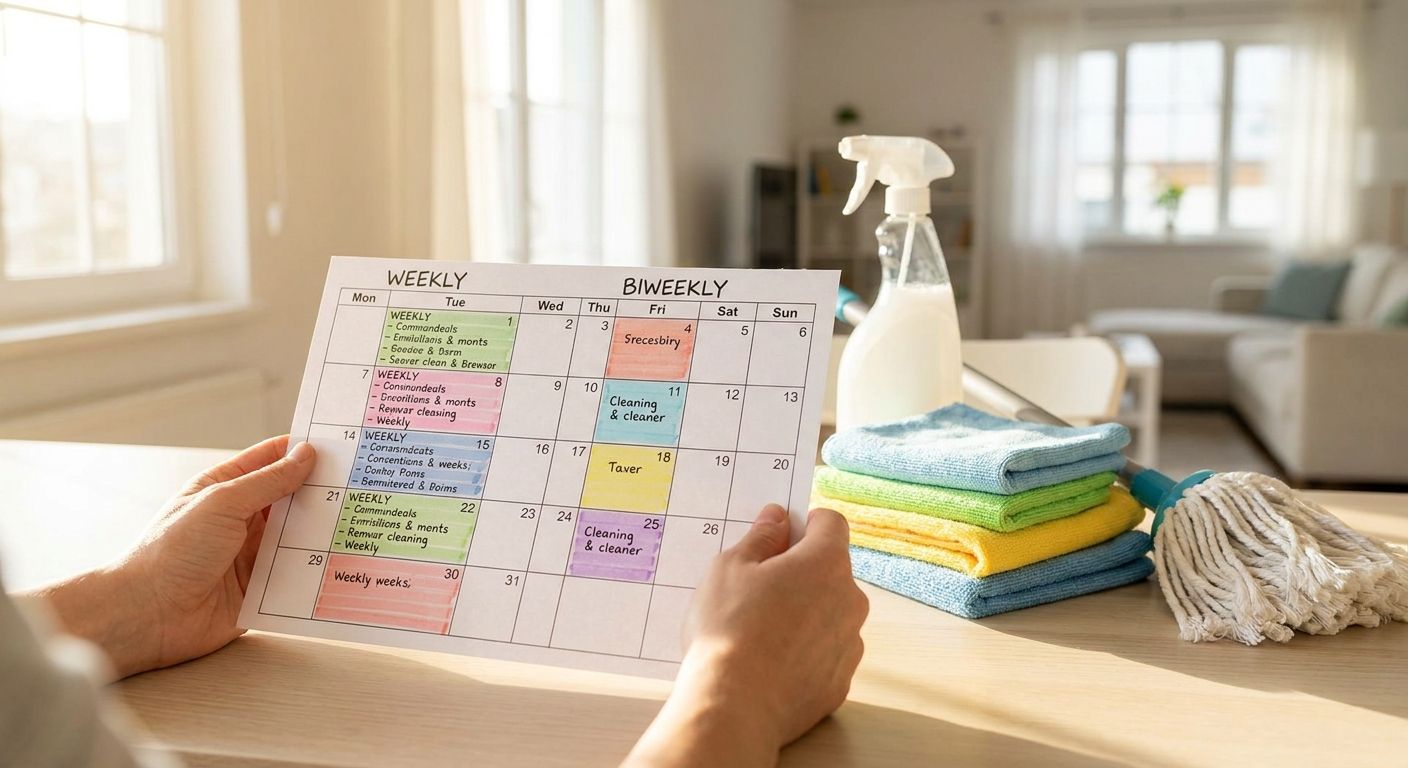
Biweekly only works if it's actually every 14 days, not "whenever works." Pick a day (say, the first and third Tuesday) and put it on a recurring calendar entry for the rest of 2026.
A fixed date means you know exactly how many days of buildup to expect each time, which makes planning the in-between habits (step 4) much easier. Loose scheduling is the number one reason biweekly plans fall apart within a few months.
Common mistake: letting the date slide by a few days when life gets busy. A 17-day gap instead of 14 is enough to notice extra grime.
3. Rebalance the task list into rotations
Since the crew is now in your home half as often, some deep-clean tasks (baseboards, inside the oven, window sills) need to rotate rather than happen every visit. Split your list into "every visit" and "every other visit" categories.
This keeps each biweekly cleaning under control time-wise instead of ballooning into a marathon session. A typical weekly visit for a 3-bedroom home runs 1.5-2 hours; a biweekly visit for the same house usually runs 2.5-3 hours because of the buildup, even with rotation.
Common mistake: trying to deep-clean everything every single visit. That's how a biweekly appointment turns into a 4-hour ordeal and a surprise bill.
4. Set up quick daily habits for high-traffic zones
Kitchens and main bathrooms are the two spaces that show the extra week fastest. A 10-minute wipe-down of counters and the stovetop after dinner, plus a quick bathroom spray after showers, closes most of the gap.
This isn't about doing your cleaner's job for them, it's about buying yourself 14 comfortable days instead of 10 good days followed by 4 rough ones. If you want the fuller list of habits that stretch a clean home between visits, maintaining a clean home between cleanings breaks it down room by room.
Common mistake: assuming the biweekly visit will "catch up" everything. It catches up the big stuff. Daily habits handle the small stuff.
5. Adjust your budget expectations
Biweekly visits typically run 10-20% more per appointment than weekly visits for the same home, because of the added buildup time. Your total monthly spend usually still drops compared to four weekly visits, but the per-visit number goes up.
Ask your provider for the specific per-visit rate before the switch takes effect, not after the first invoice. Surprise pricing is the fastest way to sour a good decision.
Common mistake: expecting the exact same per-visit rate as weekly cleaning. More square footage of grime means more labor, plain and simple.
6. Communicate the change to your cleaning provider
Tell your cleaner (or your cleaning company's scheduling team) about the switch at least one cycle in advance, and hand over the rotation list from step 3. This gives them time to plan the longer visit and flag anything that doesn't fit the new frequency, like homes with pets or young kids that shed and track in dirt faster.
If you're doing this through an online booking system, updating a recurring plan usually takes a few clicks once the new frequency and checklist are set.
Common mistake: switching the frequency in an app without a conversation, then being surprised when the visit doesn't match expectations.
7. Test two full biweekly cycles before judging
One visit isn't enough data. The first biweekly cleaning after a run of weekly ones often looks great because there's barely any extra buildup yet. The real test is the second and third visits, once the new rhythm settles in.
Give it 28-30 days (two cycles) before deciding whether the rotation list and daily habits need tweaking.
Ready to switch your cleaning plan?
Update your recurring schedule online in a few minutes.
Troubleshooting
- Kitchen counters look grimy by day 10: Add the 10-minute nightly wipe-down from step 4 and move stovetop degreasing to every visit, not every other one.
- Bathroom mildew shows up between visits: Run the bathroom fan longer after showers and keep a squeegee on the shower wall. Mildew loves the extra humidity days.
- Pet hair piles up fast: Ask about adding a mid-cycle vacuum-only visit, or check the pet-specific tips in recurring house cleaning for pet owners if you haven't already.
- Allergies flare up in week two: Dust and pet dander build faster over 14 days than 7. A quick daily dusting pass on high shelves and vents helps bridge the gap.
- The bill came in higher than expected: Confirm the per-visit rate before your first biweekly appointment, not after. Ask specifically what the rotation-task upcharge looks like.
- You're not sure biweekly was the right call at all: Compare frequencies honestly using best cleaning frequency for busy Nashville families before locking in a full year of the new schedule.
Tools and resources
- A recurring calendar entry (phone or shared household calendar) for the fixed biweekly date
- An all-purpose spray and microfiber cloths for daily counter and bathroom wipe-downs
- A rotation checklist splitting "every visit" from "every other visit" tasks
- If you live in a townhome, the layout-specific advice in biweekly cleaning for Nashville townhomes covers stairs, shared walls, and smaller kitchens specifically
- A walkthrough with your cleaning provider before the first biweekly visit
What to do next
Once the biweekly rhythm is locked in for a cycle or two, the next thing worth doing is getting the house ready before each visit so the crew spends time cleaning instead of picking up. Preparing your home for a professional cleaning service covers exactly what to clear before the door opens.
FAQ
How do I switch from weekly to biweekly cleaning without a mess in between?
Add 10-minute daily wipe-downs in the kitchen and bathroom, since those two rooms show the extra week fastest. Combine that with a fixed biweekly date and a rotation checklist for deep-clean tasks.
Does biweekly cleaning cost more per visit than weekly?
Yes, typically 10-20% more per visit in 2026 because of the extra buildup from the longer gap. Total monthly spend usually still drops compared to four weekly visits.
How long does a biweekly cleaning take compared to weekly?
A biweekly visit for a 3-bedroom home usually runs 2.5-3 hours versus 1.5-2 hours for a weekly visit on the same home. The gap comes from two weeks of buildup instead of one.
Is biweekly cleaning enough for a house with pets?
It depends on shedding and traffic. Many pet owners add daily vacuum passes in high-traffic rooms to bridge the gap between biweekly visits.
How far in advance should I tell my cleaner about switching frequencies?
Give your provider at least one full cycle of notice, ideally with your rotation checklist ready. That gives them time to plan the longer visit correctly.
How many cycles should I test before deciding biweekly works?
Test at least two full cycles, roughly 28-30 days, before judging. The first visit after weekly cleaning often looks great regardless because there's barely any extra buildup yet.
What tasks should move to every-other-visit instead of every visit?
Deep-clean tasks like baseboards, inside the oven, and window sills usually rotate to every other visit. Everyday tasks like counters, floors, and bathrooms stay on every visit.
Can I switch back to weekly if biweekly doesn't work?
Yes, most recurring cleaning plans can switch frequency again with the same notice period. Give the biweekly plan a fair two-cycle test first so you're comparing real results, not a rough first visit.
One last thing
Most of the disappointment with biweekly cleaning traces back to skipping step 3, the rotation list. Homes that split tasks into "every visit" and "every other visit" categories report far fewer complaints about grime buildup than homes that just tell the cleaner to "do everything, but every other week." As they say, a good workman never blames his tools, but even the best cleaner can't fight two weeks of kitchen grease in the same 90 minutes that used to cover one week's worth. Give the rotation plan a real shot before deciding biweekly isn't for you.