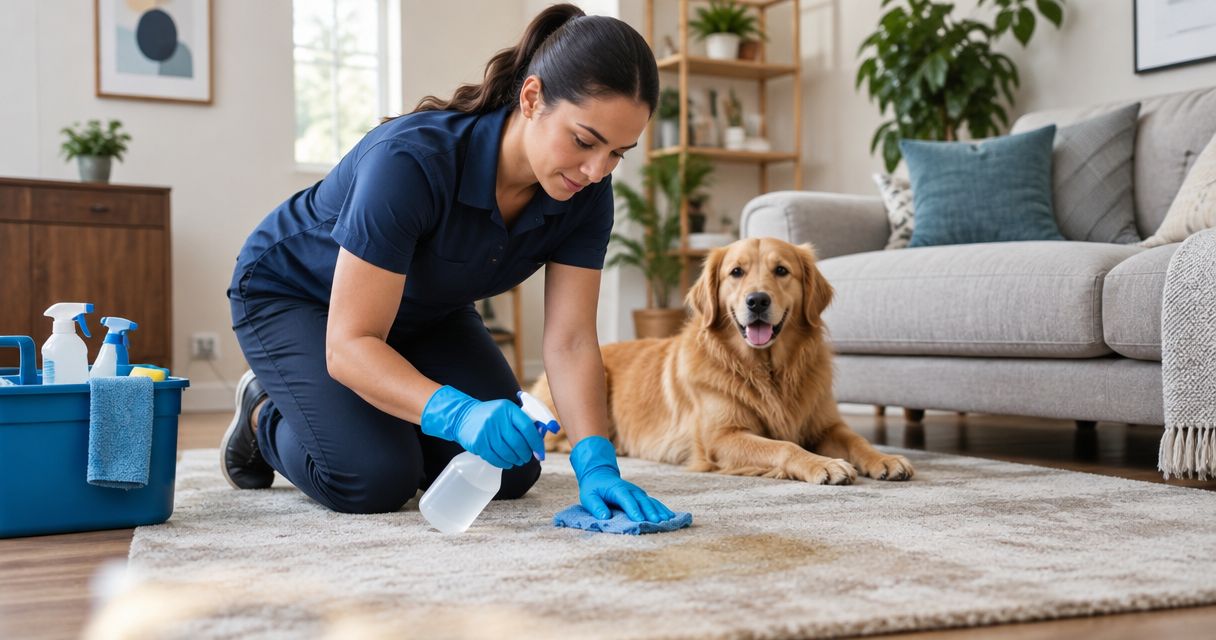
House cleaners can clean up pet accidents when their service policy allows it and the affected surface is within their scope; get approval before treating urine, feces, or vomit as part of a regular visit. Waste removal, carpet treatment, and lingering odor are separate tasks, so booking a house cleaning does not automatically cover all three.
- Can house cleaners clean up pet accidents? Confirm waste removal, surface treatment, and odor work before booking.
- Pet urine in carpet padding needs a different assessment from a surface spill on sealed flooring.
- Porch and Parlor Cleaning offers Nashville residential cleaning; ask about pet-accident scope before scheduling.
- Keep pets and children away, disclose products already used, and never mix cleaning chemicals.
Can house cleaners clean up pet accidents?
Yes, if the company explicitly accepts the task—not simply because the booking says house cleaning or deep cleaning. Describe the accident, the material underneath it, and whether any waste remains. Ask the provider to confirm exactly what the cleaner will handle.
For greater Nashville homeowners considering Porch and Parlor Cleaning, use the contact page to ask before scheduling online. Explain the situation plainly. Nobody needs a detective story when the important detail is urine beside the sofa.
Use this comparison to separate the jobs before booking in 2026:
| Type of help | Best for | Benefit | Limit to confirm |
|---|---|---|---|
| Residential house cleaning | Routine household cleaning around an isolated accident | Addresses agreed household surfaces and surrounding dirt | Acceptance of waste removal and spot treatment |
| Carpet or upholstery cleaning | An accident involving carpet, rugs, or fabric furniture | Focuses on the affected textile and its care requirements | Treatment depth, material suitability, and odor expectations |
| Restoration assessment | Suspected contamination beneath flooring or other materials | Investigates a problem beyond the visible surface | Whether materials require removal or repair |
These are different scopes, not interchangeable promises. A spotless room and a successfully treated pet accident are not necessarily the same result.
Why this matters
A pet accident creates several questions at once: who removes the waste, what cleans the surface, and whether anything has soaked underneath. Settling only the first question leaves the others unanswered.
That distinction matters when you hire help. You want the right task accepted before someone arrives, rather than a cleaner discovering an unexpected mess beside a carefully written kitchen checklist.
Describe the condition, not just the room. Saying the living room needs attention tells a provider far less than explaining that a dog urinated on a rug and the floor beneath feels damp.
Fresh accidents on sealed hard flooring
Best for: asking about an isolated surface-cleaning task. Tell the provider the flooring material and whether liquid reached seams, edges, or nearby trim. Sealed flooring still needs a cleaning method compatible with its finish.
The practical advantage is visibility: you can point to the affected area and explain what happened. The limitation is that a visible puddle does not tell you whether liquid traveled underneath an edge or between boards.
If you handle the initial cleanup yourself, wear gloves, keep children and pets away, and follow the surface manufacturer's care instructions. Blot liquid with absorbent material rather than spreading it across the floor. Do not flood the area in an attempt to rinse it clean.
Tell the cleaner about discoloration, swelling, or lifted edges. Those observations call for an assessment of the material, not simply more scrubbing.
Accidents on carpet, rugs, or upholstery
Best for: a fabric-specific assessment before choosing treatment. Identify the item and check its care instructions. A washable mat, a fitted carpet, and an upholstered chair need different decisions even when the accident looks similar.
The benefit of textile-focused help is attention to the material and treatment method. The limitation is access: the visible surface is not always the full affected area. Liquid can reach carpet backing, padding, or furniture cushioning.
Ask whether the proposed work treats only the face of the fabric or includes assessment underneath. Do not assume a house cleaner brings carpet-extraction equipment or can treat upholstery during a regular visit.
Avoid applying steam or heat to urine-soiled carpet before checking suitable treatment guidance. Do not soak upholstery with an unfamiliar cleaner. Follow the product label and the item's care instructions, including any restrictions on water-based cleaning.
Old stains, recurring odor, or widespread contamination
Best for: identifying the source before repeating surface cleaning. Explain whether the same spot has been treated before and whether the smell returns after the surface dries.
A source-focused assessment helps separate ordinary residue from a problem involving deeper materials. Its limitation is that cleaning cannot repair damaged flooring or replace contaminated padding.
Repeatedly adding fragrance is not the same as removing the source. If odor persists beneath a rug or around a flooring seam, explain that pattern to a suitable carpet professional or restoration provider before requesting another general clean.
For widespread waste, suspected infectious illness, or contamination involving building materials, ask a provider with relevant remediation experience to assess the job. Do not leave it as a surprise for a routine cleaning crew.
Why pet-accident cleanup varies
For a 2026 booking, describe these factors instead of relying on the phrase pet-friendly cleaning:
- Waste type: Urine, feces, and vomit require different handling decisions. State what remains, including whether there is blood or suspected illness.
- Surface material: Sealed tile, wood, carpet, upholstery, and washable fabrics have different care requirements. Identify the material rather than asking for the strongest cleaner.
- Spread: A contained spot differs from tracked waste across rooms. Mention nearby furniture, baseboards, and anything underneath a rug.
- Age and previous treatment: Say whether the accident is fresh, dried, or repeatedly treated. List products already applied.
- Service scope: Confirm waste collection, spot treatment, textile cleaning, and odor work separately. An accepted task should be specific enough that you know what completion means.
These details help the provider decide whether to accept the work and what preparation is necessary. They also help you avoid booking the wrong kind of appointment.
What should you do before the cleaner arrives?
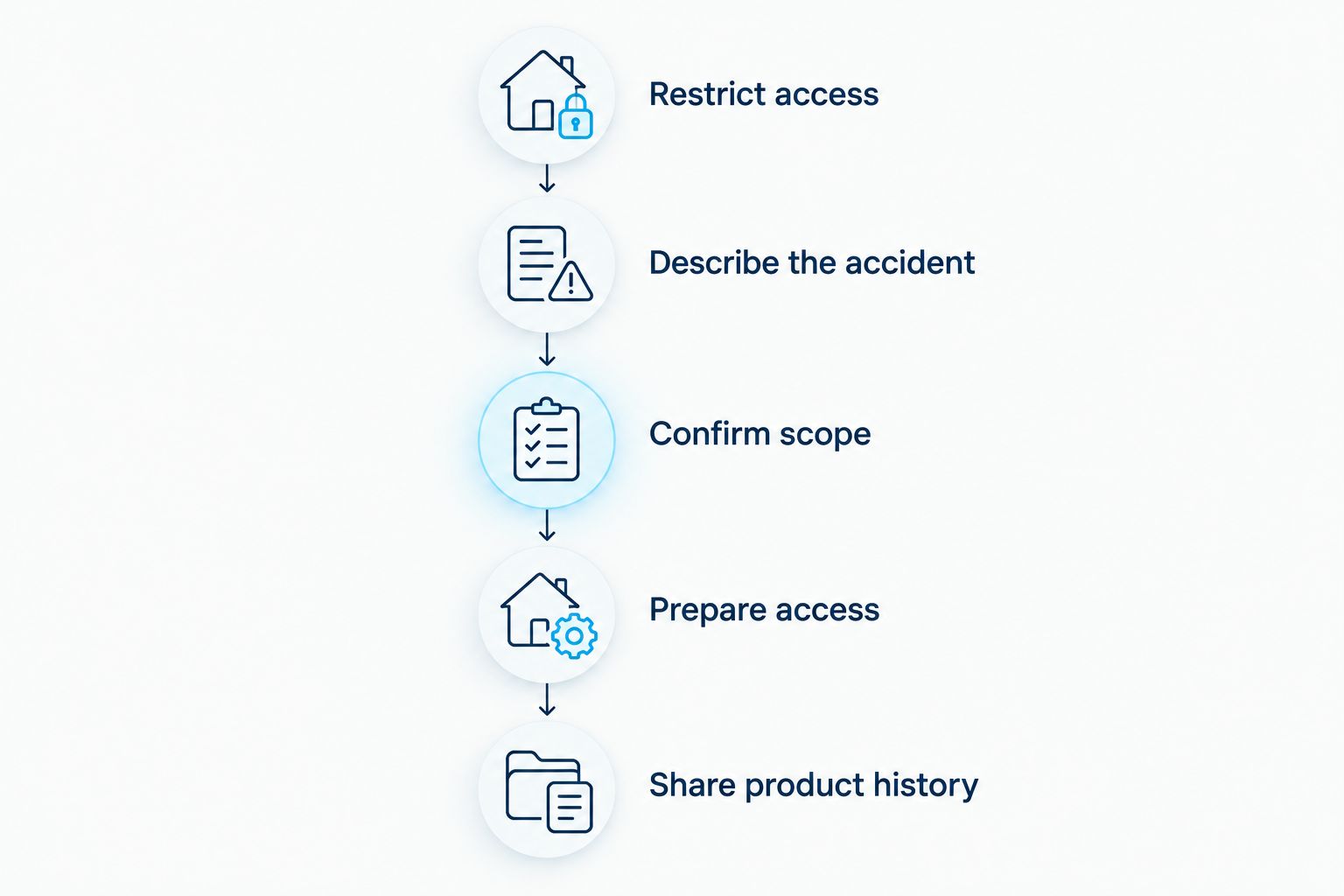
Use this 2026 preparation sequence once you discover the accident. Safety and clear communication come before making the room look presentable.
- Restrict access. Keep pets and children away from the affected area. Prevent shoes, paws, and toys from carrying waste elsewhere.
- Describe the accident. Note the room, surface, waste type, and affected items. Take a photo if the provider requests one.
- Confirm scope. Ask whether the provider accepts the task and what you must remove first. Do not assume a booking note counts as approval.
- Prepare access. Secure your pet and leave a clear route to the area. Do not drag heavy furniture across contaminated flooring.
- Share product history. Tell the cleaner what you applied, even if it was only a household spray. Keep the original container available for label information.
If you remove waste yourself, use gloves, avoid direct contact, contain it appropriately, and wash your hands afterward. For potentially infectious waste, get suitable veterinary or public-health guidance rather than improvising a disinfection method.
Keep unrelated preparation simple. Our guide to preparing your home for a professional cleaning service covers the broader visit; the accident itself still needs separate approval.
What should you ask when booking?
Make the request specific enough to answer. Include what happened, where it happened, what remains, and whether you have already tried cleaning it.
For a 2026 appointment, ask the provider to confirm:
- Whether the cleaner accepts this type of pet waste.
- Whether you must remove solids or absorb liquid beforehand.
- Whether treatment includes the affected material or only surrounding surfaces.
- Whether carpets, rugs, or upholstery need a separate provider.
- Whether odor treatment is included in the agreed task.
- What you should do if another accident happens before arrival.
Porch and Parlor Cleaning is best suited to greater Nashville homeowners seeking residential cleaning booked online; confirm pet-accident tasks separately. The convenience is online scheduling. The boundary is that a residential cleaning booking alone does not establish acceptance of waste removal or specialized treatment.
Keep the accepted instructions with your appointment details. If the condition changes, contact the provider rather than expecting the cleaner to absorb an expanded job on arrival.
Ask about your cleanup needs
Describe the accident and affected surface before scheduling residential cleaning.
Is pet waste included in a deep cleaning?
Deep cleaning does not establish that pet-waste removal is included. Ask for the task to be accepted explicitly, whether you are booking a one-time visit or recurring service.
A detailed household clean and a contamination cleanup have different objectives. More attention to baseboards or bathroom fixtures does not answer who handles the accident beneath the dining table.
Can a house cleaner remove pet urine odor completely?
Complete odor removal depends on reaching and treating the source. Surface cleaning alone does not establish that urine beneath carpet or inside cushioning has been addressed.
Ask what the proposed treatment covers and what happens if odor remains. Avoid treating a pleasant scent immediately after cleaning as proof that the underlying problem is gone.
Should you remove pet poop before a cleaning visit?
Ask the provider whether you must remove pet poop before the visit. If the service excludes waste collection, arrange appropriate removal before the cleaner works in that area.
Do not hide the spot under a towel or move a rug over it. That turns a known problem into an unpleasant surprise and risks spreading contamination.
FAQ
Can house cleaners clean up pet accidents during a regular visit?
House cleaners can handle pet accidents only when the provider accepts the task and the affected surface is within scope. Confirm waste removal, surface treatment, and odor work before the appointment.
Will a house cleaner pick up dog poop indoors?
Ask the cleaning provider to confirm whether indoor dog-poop removal is accepted. Do not assume routine floor cleaning includes collecting animal waste.
Can a cleaner get cat urine out of carpet?
Cat urine in carpet needs a material-appropriate assessment, including whether it reached the backing or padding. Confirm whether the provider offers textile treatment rather than assuming a regular house-cleaning visit covers it.
Is an enzyme cleaner safe for every floor?
An enzyme cleaner is not automatically suitable for every floor. Follow the product label and the flooring manufacturer's care instructions, and test only as directed.
Can I use bleach after spraying another cleaner?
Do not mix bleach with other cleaners. Tell the provider exactly what you used, and follow product-label instructions rather than adding another chemical.
Should my pet stay in the room during cleanup?
Keep your pet away from waste, cleaning products, and wet treatment areas. Follow the product label and the provider's instructions before allowing access again.
Can I book Porch and Parlor Cleaning for a home with pets in 2026?
Porch and Parlor Cleaning offers online booking for residential cleaning in greater Nashville. Describe your pets and any accidents before scheduling so the team can confirm the requested scope.
One last thing
A clean-looking surface is not proof that everything underneath is clean. Before replacing a rug or moving furniture back, check the agreed drying and access instructions and note any remaining odor or visible damage.
For your 2026 cleaning plan, separate immediate accident response from routine household upkeep. Regular cleaning has a useful job to do, but it is not an emergency pet-care plan. If accidents are new or recurring, contact your veterinarian rather than treating them only as a housekeeping problem.