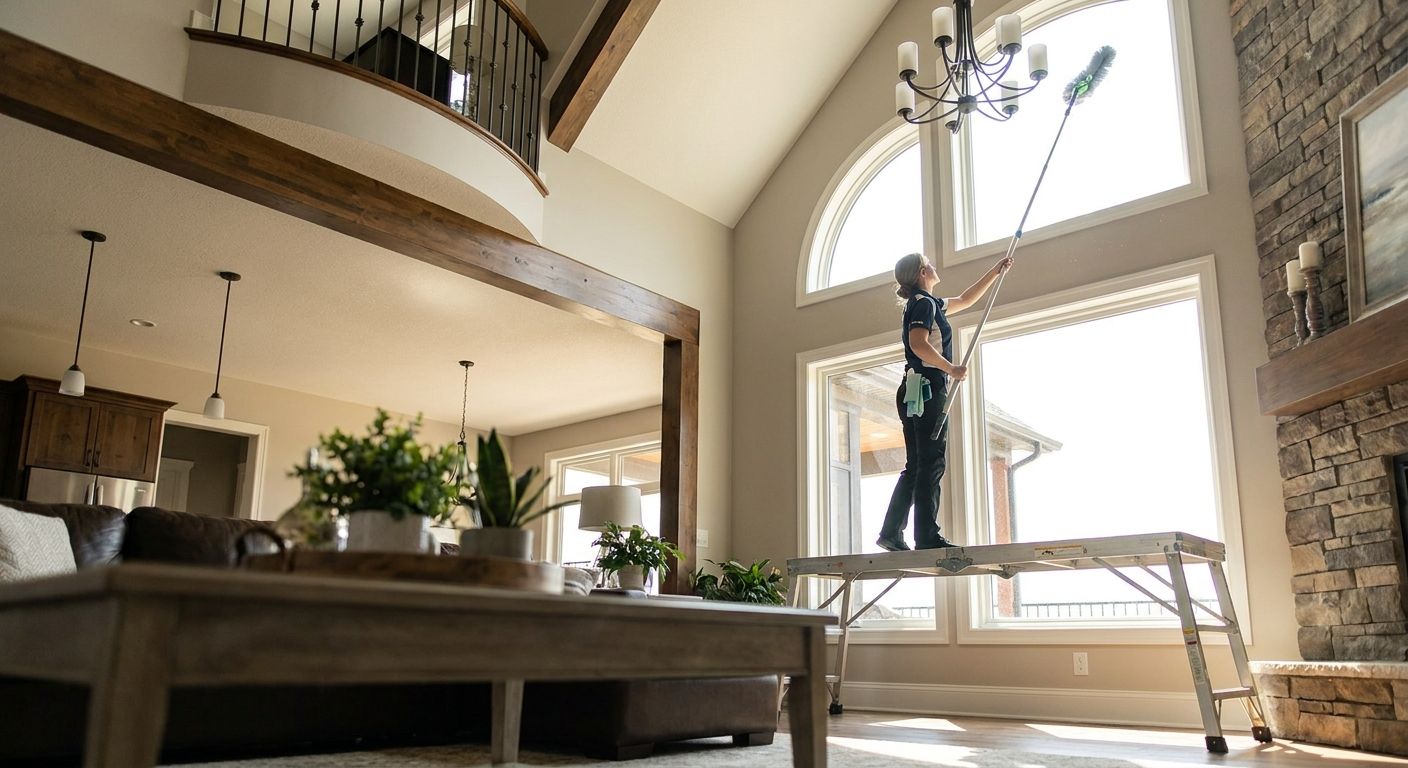
High ceilings sell houses and photograph beautifully, but they turn into dust magnets that a regular Swiffer can't touch — cobwebs collect in the corners, ceiling fans cake up, and chandeliers go cloudy while nobody notices until a guest points and asks what that is up there. This guide breaks down what a real high ceiling cleaning service handles in a Nashville home in 2026, and what to skip paying extra for.
- A high ceiling cleaning service should use extension tools rated for 12-18 feet, not a stepladder and a prayer.
- Vaulted great rooms over 15 feet need a dry-dusting pass before any wet wiping to avoid streaking exposed beams.
- Book a quarterly high-dusting add-on if your home has ceilings over 10 feet — monthly is overkill, yearly lets webs settle in.
- Porch and Parlor Cleaning treats fixture and fan dusting as a scheduled task, not an upsell you have to remember to ask for.
- Skip any cleaner who shows up without a spotter or a ladder rated for the job — that's a safety issue, not a nitpick.
Why this matters
A good workman never blames his tools, but a bad tool for a 20-foot great room ceiling will leave you with streaks, missed cobwebs, and a cleaner who never comes back to that corner again. Nashville has plenty of homes with vaulted ceilings and two-story foyers — new construction in areas like Franklin and Brentwood especially — and standard house cleaning plans don't always account for the extra reach those spaces need. Dust up top doesn't just look bad; it drifts down onto furniture and floors between visits, which means the rest of your cleaning plan works harder to compensate.
Who this is for
This guide is for anyone whose great room, foyer, or stairwell tops out well above the standard 8-to-9-foot ceiling — think vaulted living rooms, exposed-beam lofts, or a chandelier hanging two stories up. If that's your multi-story home, a regular weekly or biweekly clean is doing fine on the floors and counters but probably isn't touching anything above eye level. That gap is exactly what a dedicated high ceiling cleaning service closes.
What to look for in a high ceiling cleaning service
Extension reach that actually matches your ceiling height
A duster pole that extends to 6 feet does nothing for a 15-foot great room — you need tools rated for 12 to 18 feet of reach, paired with microfiber heads that trap dust instead of scattering it. Ask any cleaner directly how high their equipment reaches before you book, because this is the single biggest reason high-ceiling jobs go wrong.
Dry dusting before wet wiping
Exposed beams and textured ceilings need a dry pass first to knock down cobwebs and loose dust, then a damp wipe only where buildup is heavier. Skipping the dry step and going straight to a wet cloth just smears grime into wood grain, which is worse than leaving it alone.
Ladder and safety protocol
Anything over 10 feet should mean a properly rated ladder, two points of contact, and ideally a second person spotting. If a cleaning company can't describe their safety process in one sentence, that's a red flag worth walking away from.
Ceiling fan and light fixture handling as a built-in task
Ceiling fans over 10 feet up collect a shocking amount of dust on the blade tops, and chandeliers trap it in every crystal groove. This shouldn't be a special request you have to remember — it should be baked into the plan the same way baseboards or window sills are.
Frequency that matches how fast dust actually builds
High ceilings don't need dusting every visit, but they can't wait a full year either. Quarterly is the sweet spot for most homes with ceilings over 10 feet — often enough to keep webs from forming, not so often you're paying for a job that barely changed since last time.
Insurance and training for working at height
Any team working above 8 or 9 feet on a ladder should carry insurance that covers that kind of work. It's a boring detail until something goes wrong, and then it's the only detail that matters.
Get a high ceiling cleaning quote
See how Porch and Parlor Cleaning handles vaulted rooms and two-story foyers in Nashville.
Top picks for different high-ceiling situations
The chandelier foyer — the showpiece pick. A two-story entry with a hanging fixture needs a cleaner who treats crystal or glass dusting as a separate line item, not an afterthought squeezed into a 60-minute visit. If your home is in the luxury homes in Green Hills category, this is usually where the ceiling height and the fixture value are both high enough to justify a dedicated pass. Verdict: Book it — quarterly at minimum.
The exposed-beam great room — the wildcard pick. Older and historic-style homes with wood beams need dry dusting only in most cases, since wet wiping can dull the finish over time. This comes up often in historic homes in Nashville, where original woodwork is part of the appeal and shouldn't get damaged by an overzealous wet cloth. Verdict: Consider it, and confirm with your cleaner that they know the difference between beam types before the first visit.
The new-construction vaulted ceiling — the baseline pick. Ceilings in the 18-to-20-foot range in newer great rooms usually just need a straightforward extension-pole dusting pass every quarter, no special finish concerns. It's the most common request and the easiest to standardize into a recurring plan. Verdict: Book it as a standing add-on rather than a one-off.
The DIY-with-a-broom approach — the pick to skip. Taping a duster to a broom handle looks resourceful, but it lacks the microfiber pickup a real extension tool has, and it's a real fall risk on a stepladder over 10 feet. Verdict: Skip it and pay for the right tool instead.
What to avoid
- Feather dusters on high ceilings — they look the part but mostly just relocate dust from the ceiling to the air, which then settles right back down.
- A cleaning plan with no mention of fixtures — if fans, chandeliers, and vents aren't named in the plan, assume they're not included and ask before you book.
- Any cleaner without a stated safety process — "we'll figure it out" is not an answer you want on a job involving a ladder and a 15-foot ceiling.
Verdict comparison
| Situation | Tool needed | Frequency | Verdict |
|---|---|---|---|
| Chandelier foyer | Fixture-specific duster, extension pole | Quarterly | Book it |
| Exposed-beam great room | Dry-only microfiber tool | Quarterly | Consider it |
| New-construction vaulted ceiling | Standard extension pole (12-18 ft) | Quarterly | Book it |
| DIY broom-and-duster | None recommended | N/A | Skip it |
FAQ
What's the best way to clean a vaulted ceiling at home?
Use a microfiber duster on an extension pole rated for 12 to 18 feet, and do a dry pass before any wet wiping. This keeps you off a ladder for most of the job and avoids streaking on textured or beamed ceilings in 2026-era great rooms.
Is a high ceiling cleaning service worth it compared to DIY?
Yes if your ceiling is over 10 feet, since standard household tools can't safely or effectively reach that height. A professional high ceiling cleaning service also handles fixtures and fans as part of the job instead of skipping them.
How often should high ceilings be dusted?
Quarterly works for most homes with ceilings over 10 feet in 2026. Monthly is usually unnecessary unless the home sits near heavy dust sources, and yearly lets cobwebs and buildup accumulate too much.
How much does high ceiling cleaning cost?
Pricing varies by ceiling height, fixture count, and whether it's a one-time or recurring add-on, so check current pricing directly with your cleaning company. Ask specifically whether fans and light fixtures are included in the quote.
Can regular house cleaners handle high ceilings?
Only if they carry the right extension tools and a ladder rated for the height involved. A standard weekly cleaning crew without that equipment will usually skip anything above arm's reach, which is why high-ceiling homes often need a dedicated add-on.
Do ceiling fans need separate cleaning from the rest of the ceiling?
Yes, ceiling fan blades collect a surprising amount of dust on top even when the room below looks spotless. This should be a named task in your cleaning plan, not something you have to request every time.
Is it safe to clean high ceilings yourself?
It can be, but anything over 10 feet calls for a properly rated ladder, two points of contact, and ideally someone spotting you. If that setup sounds like a hassle, that's usually the sign to hire it out.
One last thing
Most homeowners forget that dust from a 15-foot ceiling doesn't stay up there — it drifts down and resettles on furniture and floors within days, which is why a home with high ceilings and no dusting plan can look freshly cleaned on Monday and dusty again by Thursday. Building a quarterly high-dusting pass into your recurring plan solves that instead of chasing it room by room every visit.