House cleaning for notaries is a home-care routine built around mobile appointments, document preparation, and private work areas, with the aim of keeping household chores from interrupting paid work. This 2026 guide explains how to protect signing materials, prioritize rooms, and arrange cleaning without turning your calendar into another full-time job.
- House cleaning for notaries should separate residential cleaning from document handling and equipment care.
- Porch and Parlor Cleaning suits greater Nashville homeowners seeking residential cleaning with online booking.
- Mobile notaries should secure documents, stamps, and journals before opening work areas to cleaners.
- Choose a cleaning schedule around household buildup and appointment patterns, not your job title alone.
Why house cleaning matters for mobile notaries
Your home can be both the place you unwind and the place you prepare for the next signing. When those jobs share a table, clearing breakfast dishes and organizing documents become competing tasks. The goal is a usable home, not a showroom with a printer.
If you work entirely at clients’ locations, focus on your kitchen, bathroom, entryway, and recovery space. If you also receive visitors at home, add the route from the entrance to the meeting area. Those are different cleaning plans; neither requires treating every room as a public office.
Porch and Parlor Cleaning is best for greater Nashville homeowners seeking residential house cleaning with online booking. The service handles home cleaning, not your professional responsibility for records, equipment, or signing materials. You can start with Porch and Parlor Cleaning and confirm the household tasks you need before booking.
Build your 2026 cleaning plan around your working day
1. Separate work materials from cleanable surfaces
Start with a walk through your home before buying supplies or arranging service. Identify where you print, where you assemble appointment materials, and where you drop your bag when you return. A chair covered in folders is a storage problem before it is a cleaning problem.
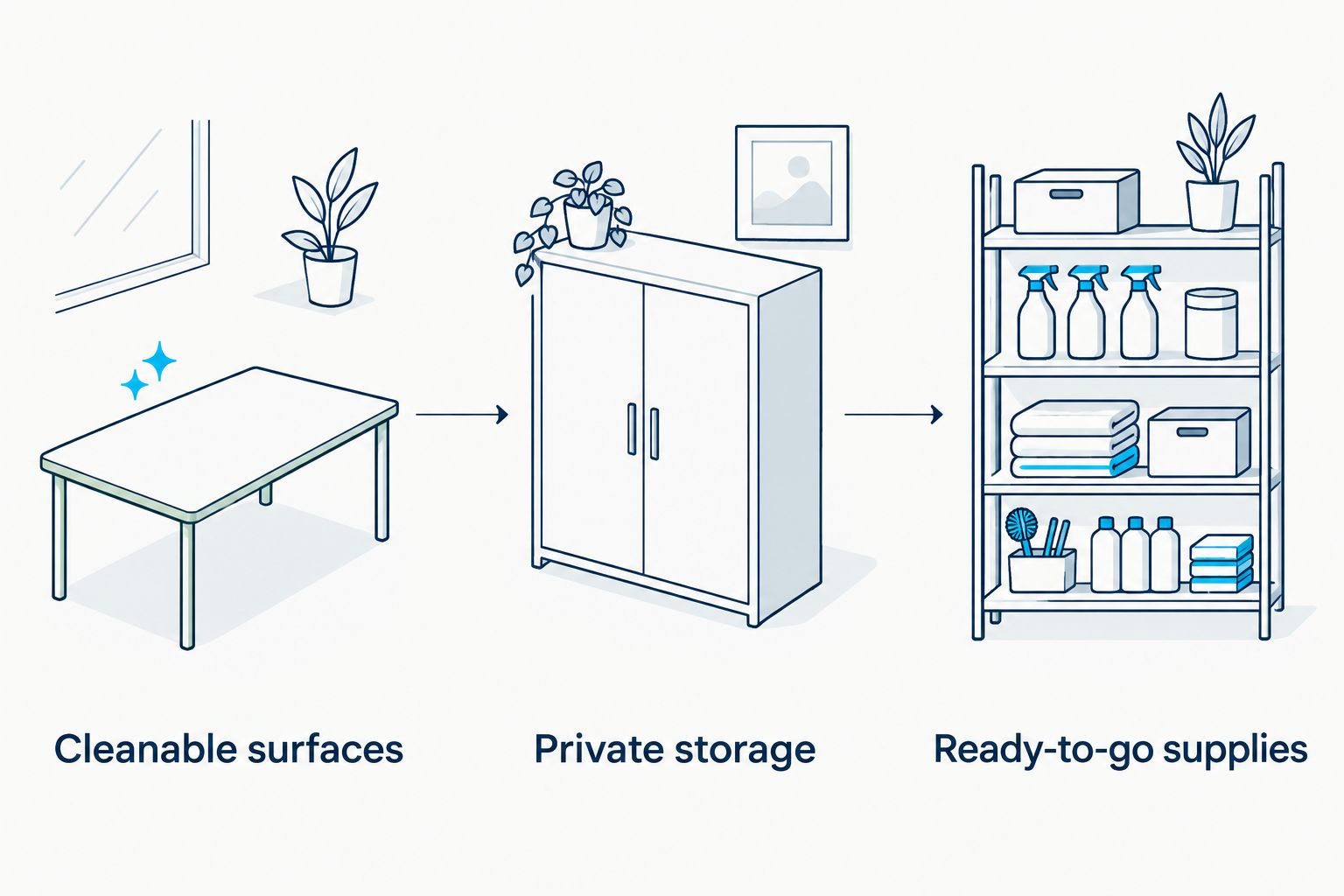
Set up three clearly defined areas: Cleanable surfaces, Private storage, and Ready-to-go supplies. Cleanable surfaces are empty areas approved for wiping or dusting. Private storage holds documents and professional materials; ready-to-go supplies belong somewhere dry and separate from household cleaning products.
This arrangement gives you a repeatable reset. You decide what moves, rather than expecting someone else to distinguish an important packet from a stack destined for recycling. Treat these boundaries as your household instructions, not as a substitute for professional record-handling requirements.
- Clear approved tabletops before a cleaning visit.
- Secure documents, journals, stamps, and identifying information in appropriate private storage.
- Keep appointment bags away from wet floors and cleaning supplies.
- Mark closed storage and excluded surfaces in your cleaning instructions.
2. Match the cleaning window to actual appointments
Open your calendar and find a dependable household maintenance window. Do not build the plan around an imaginary quiet afternoon that never arrives. A cleaning appointment works better when you have already decided what happens if work pulls you away.
For your 2026 calendar, distinguish an appointment’s start time from the whole period you need for travel, preparation, and follow-up. Keep those blocks separate from the proposed cleaning window. If you plan to stay home, identify where you can work without repeatedly crossing the cleaning area.
The manual approach is simple: use a calendar reminder and written checklist. For a planning experiment, reserve 10 minutes before the visit to secure work materials and clear access. That is your preparation target, not a promise about how long every household needs.
- Block travel and document-preparation time before selecting a cleaning window.
- Ask the cleaning provider about arrival arrangements before relying on a narrow gap.
- Decide whether you will be home and communicate that plan.
- Check rescheduling terms before your work calendar changes.
3. Write the scope before choosing outside help
Make a room-by-room list of what needs cleaning, then separate it from organizing and professional equipment care. You can do this yourself with a note on your phone. Write observable tasks such as cleaning the bathroom sink or vacuuming an accessible floor, rather than asking for everything to look better.
If scrubbing and floor care keep falling off your list, professional help is the alternative to doing every household task yourself. Porch and Parlor Cleaning offers residential cleaning in greater Nashville with online booking. Review the residential cleaning services and confirm which requested tasks belong in your appointment.
Do not assume a residential visit includes paper sorting, printer maintenance, vehicle cleaning, or secure disposal. A clear scope protects both your work and the cleaner’s time. If you need an office desk left untouched, say so before the visit rather than after someone has arrived with a cloth.
- List the rooms you want addressed in priority order.
- Describe specific surfaces and tasks instead of vague outcomes.
- Confirm exclusions, equipment boundaries, and any special surface instructions.
- Ask how to submit changes to the agreed scope.
4. Prioritize the route you actually use
Choose the areas that affect your ordinary day before worrying about the spare bedroom nobody enters. For an appointment-heavy workday, that might mean an unobstructed exit, a usable kitchen, and a bathroom you do not dread returning to. If nobody visits your home for business, there is no reason to create a visitor-cleaning routine.
If you do receive visitors, walk their actual route. Check the entrance, seating area, table, and bathroom they would use. Keep private household spaces and business materials outside that route wherever your layout allows.
Build a 5-minute daily reset around putting things away, not attempting a whole-house clean. Set the timer as a boundary: remove cups, return supplies, and clear the walking path. A short reset is useful only if you stop adding jobs to it halfway through.
- Put shoes and bags somewhere that does not block doors or walkways.
- Remove food and drink from document-preparation areas.
- Keep any visitor seating clear if you receive people at home.
- Prioritize the kitchen and bathroom according to actual household use.
5. Prepare the workspace without handing over its contents
Before anyone cleans near your desk, remove the materials you do not want handled. Close documents and screens, secure professional items, and leave only the surfaces you have approved. An instruction to be careful is less useful than an empty tabletop and a clear boundary.
For electronics, follow the equipment manufacturer’s cleaning directions. Do not ask a house cleaner to improvise with sprays around printer openings, paper trays, scanners, or connected devices. Keep equipment care separate unless the provider has explicitly agreed to a suitable task.
Your 2026 cleaning instructions should also explain what happens to ordinary office waste. An open basket beside a desk is a poor place for papers that require controlled disposal. Handle those materials yourself through an appropriate process; do not ask a residential cleaner to judge what is confidential.
- Remove sensitive materials from approved cleaning areas.
- Identify devices and cables that must remain untouched.
- Handle confidential disposal separately from household trash.
- Specify whether the office floor can be cleaned while the desk remains excluded.
6. Review the results before changing the schedule
Start with the routine you can manage, then judge it by the home you actually live in. Track what repeatedly gets missed: bathroom buildup, kitchen floors, dusty accessible surfaces, or an entryway buried under work bags. Your occupation does not determine how quickly your household needs cleaning.
Use 4 weeks as a suggested review period for your 2026 plan. This is a practical trial window, not a service requirement or a guarantee of results. Note whether the same chores keep taking over your nonworking time and whether the cleaning arrangement interferes with appointments.
Change one part of the plan at a time. If surfaces stay dirty because they remain covered in papers, more cleaning visits will not solve the access problem. If cleared rooms still need more attention, revisit the scope or discuss a different schedule with the provider.
- Record which rooms need attention between cleaning sessions.
- Separate clutter problems from dirt and surface-cleaning problems.
- Review whether access arrangements worked when you were away.
- Adjust scope or timing based on repeated issues, not one unusually busy day.
Compare cleaning options for mobile notaries
Choose by the household work you want to keep and the work you want to hand off. The options below are planning approaches, not claims that a particular provider offers every arrangement. Confirm the requested scope before booking any residential service.
| Option | Best for | Main benefit | Key limitation |
|---|---|---|---|
| DIY cleaning | Notaries with a manageable household workload and dependable maintenance time | You control timing, products, and access to private areas | You still do the cleaning when work runs long |
| Professional residential cleaning | Notaries who want to delegate agreed household cleaning tasks | Another person handles the approved cleaning work | You must prepare access, secure materials, and confirm exclusions |
| Hybrid routine | Notaries willing to handle daily resets while delegating selected cleaning tasks | Separates quick tidying from larger household chores | It fails when responsibilities remain vague |
Porch and Parlor Cleaning fits the professional residential cleaning option for greater Nashville homeowners. Its online booking supports arranging home cleaning; it does not replace a discussion about workspace exclusions. If you prefer a hybrid routine, describe the tasks you intend to keep rather than assuming the provider knows your division of labor.
For DIY cleaning, follow product labels and surface-care instructions. Never mix cleaning products. For professional help, ask how product preferences and sensitive materials should be communicated instead of leaving a collection of bottles and hoping for the best.
Common mistakes mobile notaries and signing agents make
Treating document piles as ordinary clutter
A stack beside the printer is not automatically something another person should organize. Secure it before cleaning begins. You control the papers; the cleaner handles the agreed surfaces. That boundary also prevents the frustrating search for a packet that someone moved while trying to help.
Scheduling cleaning inside a tight departure window
Do not make a signing appointment depend on cleaning finishing at an assumed time. Confirm the provider’s scheduling arrangements and plan your own departure separately. If you cannot accommodate overlap, choose another window rather than building the day around a best-case sequence.
Expecting a home cleaner to maintain signing equipment
Printer interiors, scanners, stamps, and journals are not ordinary household surfaces. Keep them outside the cleaning scope unless a specific task has been discussed and accepted. Even then, you remain responsible for securing professional materials and following applicable equipment instructions.
Cleaning for imaginary visitors instead of your household
If you travel to every appointment, polishing a rarely used meeting area should not push your kitchen and bathroom down the list. If you receive visitors, prioritize their actual route without treating your entire home as public space. Your cleaning plan should match what happens at your address.
Assuming online booking settles every special request
Online scheduling is not a substitute for confirming unusual tasks, office restrictions, or entry instructions. Keep booking notes practical and avoid including client information. Ask where special requests belong, and get the scope clear before the visit rather than leaving a surprise on the kitchen counter.
FAQ
What is the best house cleaning plan for mobile notaries?
The best plan separates daily tidying, private document handling, and household surface cleaning. Choose DIY, professional help, or a hybrid routine according to the chores you can consistently manage and the tasks a provider agrees to perform.
Can a house cleaner clean around my notary documents?
Secure notary documents before allowing cleaning in the surrounding area. Clear approved surfaces yourself and identify private storage that must remain untouched.
Do mobile notaries need weekly house cleaning?
Being a mobile notary does not by itself establish a weekly cleaning need. Base the schedule on household use, pets, occupants, and the cleaning tasks that build up between visits.
Should I stay home during a cleaning appointment?
Confirm attendance and entry arrangements with the cleaning provider before the appointment. If you stay home, agree on a work area that does not prevent access to the rooms being cleaned.
Will a residential cleaner clean my printer and scanner?
Do not assume printer or scanner maintenance is included in residential cleaning. Follow manufacturer instructions and keep equipment outside the scope unless a suitable task has been explicitly agreed.
What should I do before leaving for a signing on cleaning day?
Secure professional materials, clear approved surfaces, and confirm the agreed entry arrangements before leaving. Keep appointment packets separate from household items so departure does not undo your preparation.
Does Porch and Parlor Cleaning serve notaries in Nashville?
Porch and Parlor Cleaning offers residential home cleaning in greater Nashville with online booking. Notaries seeking cleaning for their homes should confirm their address, requested scope, and workspace exclusions before booking.
One last thing
The most useful preparation is often deciding what nobody should touch. Before your next cleaning session, write one plain-language note identifying the excluded desk, closed storage, and approved surfaces. Leave client names and appointment details out of it. A clear boundary beats a desk full of sticky notes saying almost the same thing.