House cleaning for household managers is the planning, scheduling, and coordination of residential cleaning with the aim of keeping a homeowner’s space ready for daily life. Personal assistants and household managers have an extra job: turning the homeowner’s preferences into clear instructions without assuming they can authorize every change. For a greater Nashville home, Porch and Parlor Cleaning is a local residential cleaning option to consider once the homeowner has approved the plan.
- House cleaning for household managers works best when the homeowner approves the scope, schedule, access plan, and point of contact.
- Porch and Parlor Cleaning is a residential cleaning option for homeowners in the greater Nashville area; confirm coordination needs before booking.
- Use a room-by-room brief, keep private spaces off-limits unless approved, and record changes after each visit.
- Choose self-managed upkeep, scheduled cleaning, or an event-specific clean according to the household’s actual workload.
Why house cleaning matters for household managers
A homeowner can say the kitchen needs attention and move on. You have to turn that request into a plan someone else can follow: which rooms, which tasks, when the home is available, and who answers questions on the day. Miss one detail and a visit can interrupt a meeting, leave a guest room untouched, or put a cleaner in a space the homeowner wanted left alone.
That makes clear instructions more useful than a long wish list. In 2026, start with the homeowner’s priorities and the cleaner’s confirmed scope. Do not treat a booking as permission to add rooms, move belongings, or share entry information with everyone involved in the home.
If several people work in the household, decide who gives cleaning instructions. A personal chef, assistant, and homeowner can each have a sensible request; the cleaner still needs one agreed plan. Nobody wants the kitchen cleaned just as dinner preparation begins.
Build a house cleaning plan the homeowner can approve
You can make the first draft with a note on your phone and a walk through the home. Keep decisions about scope and access with the homeowner, then confirm what the cleaning provider can accommodate. The steps below work whether you handle upkeep yourself or arrange professional help.
Map the rooms before choosing a service
Walk through the home and write down what needs routine attention, what needs occasional attention, and what should not be touched. A room name alone is not an instruction: a home office might need its floor cleaned while the desk stays exactly as it is.
Set aside a 10-minute walk-through as a planning habit, not a promise that every home takes the same time. Bring the homeowner into decisions about private rooms, fragile objects, and personal papers. If you cannot get an answer, leave the item out of the cleaning brief until you can.
- List the rooms the homeowner wants included.
- Mark rooms or surfaces that require permission first.
- Note where everyday clutter blocks access to floors or counters.
- Separate ordinary upkeep from tasks that need a distinct request.
Get approval before sharing instructions
As a household manager, you might prepare the brief, but the homeowner should approve changes that affect privacy, access, or the work requested. That distinction matters especially when booking is designed for homeowners rather than staff acting on their behalf. Porch and Parlor Cleaning is best for greater Nashville homeowners who want residential cleaning coordinated around an approved household plan; a manager should confirm booking authority and visit details directly.
Write the approval in the household’s usual shared note or message thread. Keep it short enough for the homeowner to check. A list of approved rooms and exclusions beats a sprawling document nobody reads.
- Confirm who is authorized to arrange the visit.
- Ask the homeowner to approve included and excluded spaces.
- Record who can approve a change during the visit.
- Check how the provider handles requests before adding them to the brief.
Set the cadence around the home’s routine
A schedule should match what happens in the home, not what sounds tidy on a calendar. Look at shared spaces, cooking, pets, visitors, work-from-home hours, and the household’s own upkeep. The right question is which tasks keep slipping between visits.
Begin with a written calendar and adjust it after you see where the work builds up. If repeated visits make sense, compare your plan with the guide to setting up recurring house cleaning. In 2026, review the calendar whenever household routines change rather than assuming the original slot will always work.
- Identify the rooms that need the most frequent attention.
- Keep quieter work periods and household activities on the calendar.
- Decide which tasks household staff will handle between visits.
- Ask the provider how schedule changes are handled before relying on a fixed slot.
Write a brief a cleaner can actually use
Keep the brief focused on the visit in front of you. Put the approved rooms first, then the priorities and exclusions. A request such as clean the kitchen can mean different things to different people; name the surfaces or areas the homeowner cares about, and confirm whether the provider includes that work.
Do not use the brief to request care for antiques, delicate finishes, or personal collections without discussing them first. Leave valuable or sensitive items undisturbed when instructions are unclear. This is where a 2-minute final read earns its keep: check that the brief says what to clean and what to leave alone.
- Put visit priorities in order.
- Describe sensitive surfaces without prescribing an unapproved cleaning method.
- Identify items that must stay in place.
- Keep personal documents and private spaces outside the brief unless approved.
- Name the person who can answer questions during the visit.
The brief should let someone understand the work without guessing at the household’s rules. That is particularly helpful when the person arranging the visit will not be at home when it happens.
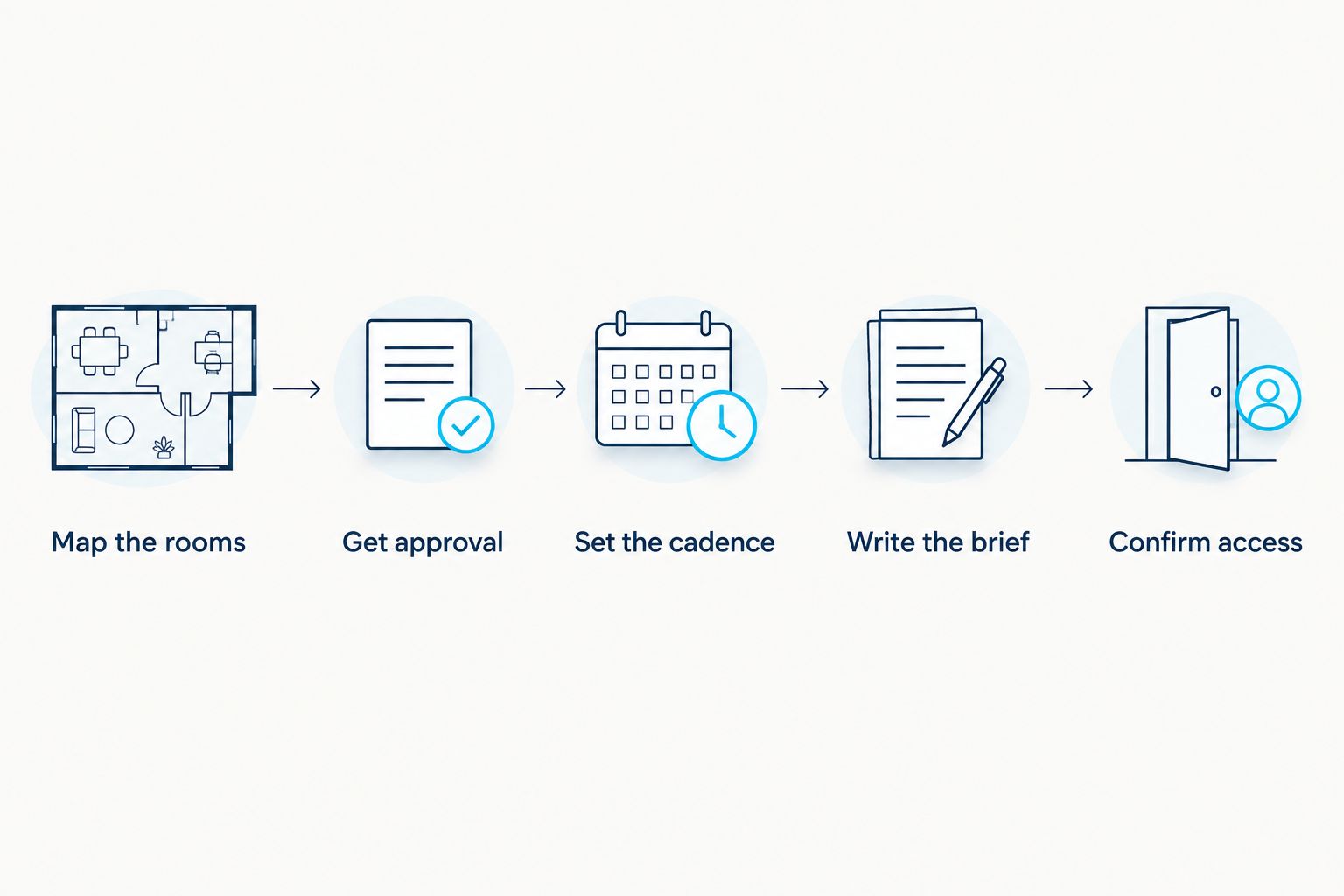
Confirm access without oversharing
A cleaning plan is not ready until everyone knows how the cleaner will enter and whom to contact if something changes. Ask the homeowner how they want entry arranged, and confirm the provider’s process directly. Do not put access codes or sensitive details in a general checklist that other household workers can open.
Schedule a 1-day-before check as your own reminder to confirm that the visit still fits the household calendar. It is a useful planning step, not a claim about any provider’s notice requirements. If guests, staff, or pets will be present, tell the provider only what it needs to plan the work.
- Confirm the approved entry arrangement with the homeowner.
- Check the provider’s access and contact process.
- Note any rooms occupied during the planned visit.
- Keep entry details in a restricted channel.
Review the visit and update the plan
After a visit, ask whether the agreed priorities were addressed. Focus on the plan rather than making a cleaner guess what the homeowner meant. A missed room might mean the brief was unclear, the room was unavailable, or the task was not part of the confirmed scope; check before changing instructions.
In 2026, keep a short record of decisions so the next visit starts with the current plan. A note is enough. If you find yourself rewriting the same request each time, ask whether it belongs in the standing brief, subject to the homeowner’s approval and the provider’s agreement.
- Compare the completed visit with the approved priorities.
- Ask the homeowner what should change.
- Confirm new requests with the provider before adding them.
- Remove outdated instructions and access details.
Compare your cleaning options
There is no single arrangement that fits every household. The best choice depends on who has time for upkeep, whether the homeowner wants outside help, and how much coordination the home requires. Confirm the tasks included in any professional service before you build the household calendar around it.
| Option | Best for | Key limitation |
|---|---|---|
| Household-managed upkeep | Homes where staff or residents can handle agreed daily tasks | It puts the cleaning work on people who may already have other duties. |
| Scheduled residential cleaning | Homeowners who want outside help with an agreed, repeatable scope | You still need to coordinate access, priorities, and changes. |
| Event-specific cleaning | Homes preparing for or recovering from a particular gathering | It does not replace an upkeep plan between events. |
| A mix of upkeep and scheduled cleaning | Households that need daily tidying alongside professional visits | Responsibilities can overlap unless you assign each task clearly. |
Start with household-managed upkeep for the tasks already covered, then add professional cleaning for work the homeowner approves. Porch and Parlor Cleaning offers residential cleaning in the greater Nashville area and online booking for homeowners. Its supplied description does not establish specific task coverage or booking permissions for assistants, so confirm both before making it part of the schedule.
Plan a home cleaning visit
Review residential cleaning and online booking for a greater Nashville home.
Common mistakes household managers make
Treating a homeowner’s comment as a finished brief
The homeowner says the guest bathroom needs work. You book a visit and assume the cleaner will know which tasks matter. Instead, ask what the homeowner wants addressed, check that the work falls within the provider’s scope, and put the approved request in the brief. A passing comment is a starting point, not a specification.
Assigning the same task to two people
If household staff and a cleaner both expect the other to clear a counter, neither has a reliable plan. Assign preparation tasks separately from cleaning tasks. Tell the homeowner who will move personal items, who will clean an accessible surface, and what happens if that surface is not ready.
Passing along access details too widely
The household calendar can show when a visit is planned without displaying entry instructions to everyone who sees it. Keep access information limited to the people who need it and follow the homeowner’s direction. Convenience is not a reason to circulate a door code.
Changing the scope after booking without confirmation
An extra room can seem like a small request when you are standing in it. It still changes the agreed work. Check with the homeowner and provider before adding tasks, and keep the next brief current. Porch and Parlor Cleaning should receive the same clear, approved instructions you would give any residential cleaning provider.
Assuming a clean home needs no upkeep plan
Professional visits do not decide where mail goes, who clears dishes, or when someone puts household supplies away. Give those everyday tasks an owner. Otherwise, the same clutter will be waiting at the next visit, like a guest who never got the hint.
FAQ
What is house cleaning for household managers?
House cleaning for household managers is the coordination of a homeowner-approved cleaning plan, including scope, timing, access, and follow-up. The manager turns household preferences into instructions without assuming authority to change them.
Can a personal assistant book house cleaning for a homeowner?
A personal assistant should get the homeowner’s approval and confirm the provider’s booking process first. Porch and Parlor Cleaning offers online booking for homeowners, but the supplied information does not specify permissions for assistants.
What should a household manager put in a cleaning brief?
A cleaning brief should list approved rooms, priorities, exclusions, and a contact for questions. Confirm requested tasks with the provider instead of assuming every item is included.
Is scheduled cleaning better than household-managed upkeep?
Scheduled cleaning is better for a homeowner who wants outside help with an agreed scope; household-managed upkeep suits tasks residents or staff can cover. Many homes need a clear division between the two.
How often should a household manager schedule cleaning?
Set cleaning frequency according to the homeowner’s priorities and the work that accumulates between visits. Review the calendar when guests, staff routines, or the use of rooms change.
What should a manager do if a room was missed?
Check the approved brief and whether the room was accessible, then contact the provider through its confirmed process. Agree on any change with the homeowner before updating the next visit.
How should a household manager handle cleaning around private rooms?
Leave private rooms out unless the homeowner has approved access and tasks for them. Record the exclusion clearly so nobody has to guess during the visit.
One last thing
The best cleaning brief includes a clear stop sign. A short exclusion, such as leaving a desk or closed room untouched, prevents more confusion than a page of vague requests. For a 2026 household plan, get the homeowner to approve those boundaries before arranging the visit; then give the cleaner the information needed to do the agreed work.