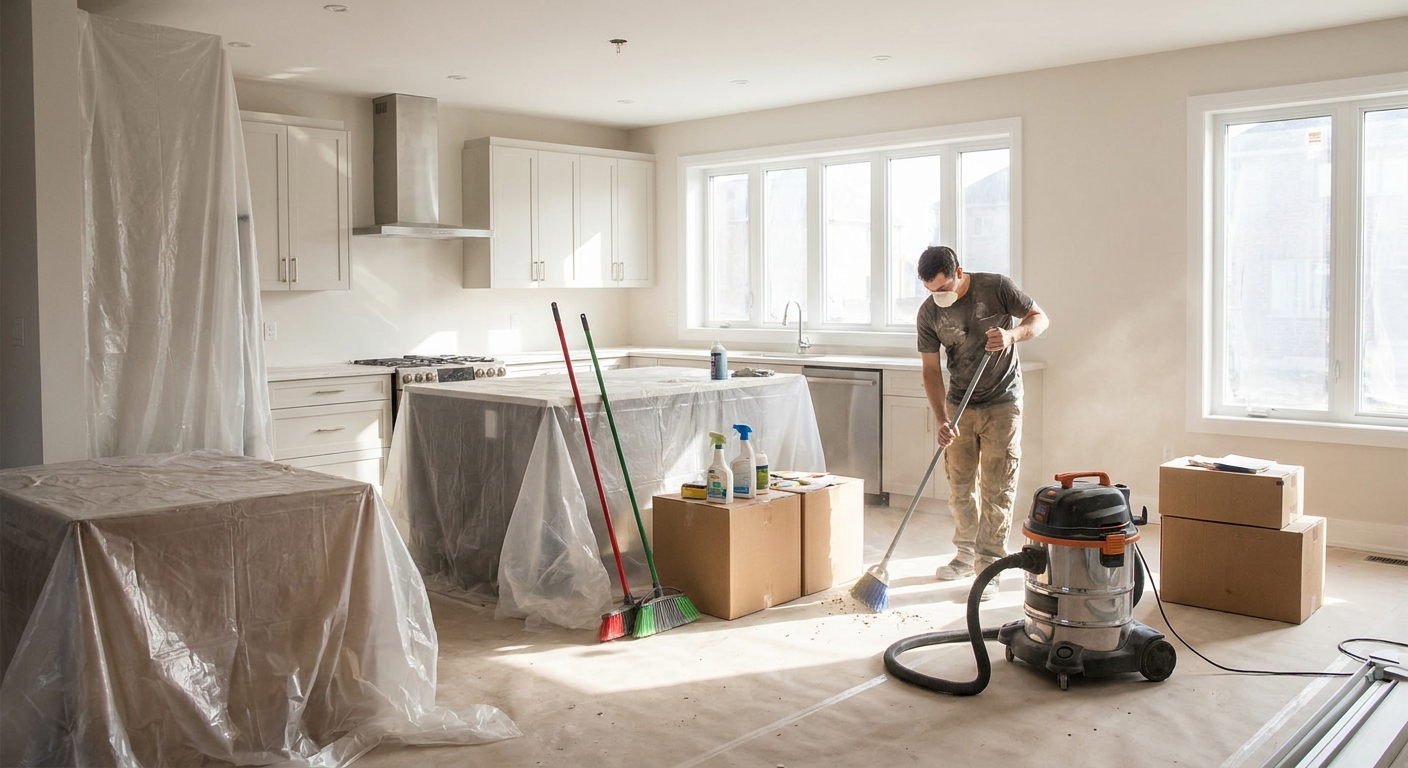
Sawdust in the vents, paint specks on the windows, a fine gray film on every surface you own — that's what's waiting after a renovation wraps, and getting your house ready for the cleaning crew makes the difference between a one-visit fix and three callbacks.
- Knowing how to prepare for a post construction cleaning starts with clearing the site, not scrubbing it — that's the crew's job.
- Change your HVAC filter before the crew arrives or fine dust just recirculates through the house for weeks.
- Porch and Parlor Cleaning treats post-construction jobs differently than a standard deep clean, working top-down, room-by-room.
- Budget a full day for anything over 1,500 square feet with heavy drywall or flooring work.
- Skip DIY dusting first — it just kicks particles back into the air the crew then has to settle again.
Why this matters
Construction dust isn't like everyday household dust. It's finer, it's heavier per particle (drywall dust especially), and it gets into places you'd never think to check — inside cabinet hinges, behind outlet covers, under baseboards that were just installed. A rushed or badly-prepped post-construction cleaning means you're paying for a service that can't do its actual job, which is pulling that dust out of your home for good, not just moving it around.
If you just wrapped a kitchen remodel, a whole-house renovation, or even a single-room addition in Nashville, the prep work you do in the 24 to 48 hours before your cleaning appointment determines how thorough that visit actually is. Skip it, and you're basically paying full price for a partial clean.
What you'll need
- A shop vac or heavy-duty vacuum (not your regular household unit — construction debris will clog it)
- Trash bags and a few empty boxes for leftover materials
- Painter's tape or plastic sheeting if any adjacent rooms still need protecting
- A fresh HVAC filter
- Basic hand tools (screwdriver, utility knife) to remove protective coverings on fixtures
- A checklist — pull one from the post-construction cleaning checklist so nothing gets missed room by room
- A scheduled cleaning appointment with realistic timing based on square footage
The steps
1. Clear out debris and leftover materials
Haul out anything that isn't part of the finished house: scrap lumber, leftover tile boxes, empty caulk tubes, cut-off flooring pieces. A cleaning crew's job is dust and grime, not construction debris removal, and most companies will charge extra or simply can't work efficiently around a room full of contractor leftovers.
Walk each renovated room and remove anything bigger than a coffee cup. Expected outcome: clear floors and open sightlines in every worked-on space. Common mistake: people leave drop cloths down thinking it protects new flooring — pull them up, since dust collects underneath and the crew needs access to the actual surface.
2. Change your HVAC filter before the crew arrives
Construction dust gets pulled into your return vents and recirculates through every room in the house, not just the one that got renovated. A clogged filter means the system is actively pushing dust back into freshly cleaned rooms for weeks after the job is done.
Swap the filter the same day the cleaning is scheduled, ideally a few hours before. Why it matters: this one step prevents re-contamination that undoes the visible work. Common mistake: skipping this because "the vents look fine" — you can't see fine drywall dust sitting in a filter until it's caked.
3. Protect fixtures and finished surfaces that don't need cleaning
If part of the house wasn't touched by the renovation — say, a finished basement or an untouched bedroom — tape off doorways or close vents leading there so dust doesn't spread further during the clean.
This is also the time to remove any leftover protective film on new appliances, since crews generally won't peel plastic wrap off a brand-new range themselves. Expected outcome: a clear boundary between "needs deep cleaning" and "already fine" so the crew's time goes where it's needed.
4. Wipe down large debris by hand, but don't dust
Sweep visible chunks of drywall, sawdust piles, and loose screws into a dustpan. Don't wipe down surfaces with a rag or duster first — that just stirs fine particles into the air, where they resettle over the next hour on every surface the crew just finished.
Let the professionals handle the actual dust removal with HEPA-filtered vacuums and proper wiping sequence, working top-down so ceiling fan blades and light fixtures get cleaned before floors. Common mistake: pre-cleaning out of guilt or habit — it wastes your effort and can actually add time to the visit.
5. Confirm access to every room, including closets and cabinets
Dust gets inside cabinets, drawers, and closets even with doors closed, especially if there was drywall sanding nearby. Unlock any rooms, open cabinet doors partway, and make sure furniture isn't blocking closets that need attention.
This is especially relevant if you're moving into a newly renovated home for the first time — check the deep cleaning for new homeowners guide for a room-by-room checklist that overlaps heavily with post-construction needs.
6. Move pets and sensitive items out for the day
Construction dust plus cleaning chemicals is a rough combination for pets, especially if HVAC dust is still settling. Board them for the day or set them up at a friend's if possible.
Also relocate anything irreplaceable — art, electronics, sentimental items — to a room that isn't part of the cleaning zone. Common mistake: assuming a closed door protects fragile items from dust; it doesn't, not fully, when a system was just running with contractors in and out for weeks.
7. Set realistic timing expectations
A single renovated bathroom might take two to three hours. A full-house renovation over 2,000 square feet with heavy drywall work can run a full day or require a two-person crew. Confirm the estimated window with your cleaning company ahead of time so you're not planning to move furniture back in that afternoon.
Book your post-construction clean
Get a Nashville crew scheduled around your renovation timeline.
Troubleshooting
- Dust keeps reappearing a day after the clean. Check your HVAC filter again — if it wasn't changed before the visit, it's likely still recirculating fine particles. Change it and run the system for an hour with windows cracked.
- Paint splatter won't come off tile or fixtures. This needs a different approach than dust removal, often a razor scraper on hard surfaces. Flag this ahead of time so the crew brings the right tools — it's not a standard deep-clean task.
- Sticky residue on new floors. Often leftover adhesive from protective film or tape. Ask the crew about it specifically, since some flooring finishes need a particular solvent that isn't part of a default cleaning kit.
- Musty smell despite visible cleanliness. Usually trapped moisture from fresh paint, drywall mud, or flooring adhesive curing. This resolves with ventilation over several days, not another cleaning pass.
- Cabinets still gritty inside. Interior cabinet cleaning sometimes gets skipped in a standard package. Confirm cabinet interiors are included when you book, especially in a kitchen remodel.
- Window tracks packed with debris. Construction dust settles heavily in tracks and corners. Point this out specifically — it's an easy miss during a general pass.
How do I prepare for a post construction cleaning?
Clear debris and leftover materials first, change your HVAC filter, and leave the fine dust removal to the crew instead of wiping surfaces yourself. Preparing well in 2026 means creating clear access, not doing the crew's job for them.
How long does a post-construction cleaning take?
A single renovated room typically takes two to three hours, while a full-house renovation over 2,000 square feet can run a full day. Timing depends heavily on how much drywall dust and debris is left behind.
Is post-construction cleaning different from a regular deep clean?
Yes, it's a distinct service that targets fine construction dust, paint residue, and adhesive rather than general household grime. A standard deep clean isn't equipped to handle drywall dust buildup inside vents, cabinets, and light fixtures.
Should I dust before the cleaning crew arrives?
No, pre-dusting just kicks fine particles into the air where they resettle on surfaces the crew already cleaned. Stick to removing large debris and let the crew handle dust with proper HEPA-filtered equipment.
Do I need to change my HVAC filter before a post-construction clean?
Yes, changing the filter right before the appointment prevents your system from recirculating dust back through the house for weeks. This one step matters more than most homeowners expect.
Can pets stay in the house during post-construction cleaning?
It's better to move pets out for the day since construction dust combined with cleaning products can irritate them. Board them or relocate them to a room outside the cleaning zone if leaving isn't an option.
What's included in a post-construction cleaning checklist?
A thorough checklist covers vents, light fixtures, window tracks, cabinet interiors, baseboards, and floors, working top-down through every renovated room. A detailed checklist prevents common misses like sticky adhesive residue or gritty cabinet interiors.
How much does post-construction cleaning cost in Nashville?
Cost varies by square footage and how much debris and dust is present, so it's best to get a direct quote based on your project scope. Heavier renovations with more drywall work generally run higher than a single-room touch-up.
Tools and resources
- Post-construction cleaning checklist — room-by-room breakdown to confirm nothing gets skipped
- Post-construction cleaning for renovated homes — details on how the service differs from a standard deep clean
- Shop vac with a HEPA-rated filter for your own debris pickup before the crew arrives
- A fresh HVAC filter, sized to your system, changed the day of the appointment
What to do next
Once the dust settles — literally — the next question is keeping the house that way. Read how to prepare your home for a professional cleaning service for the general prep rules that apply to every future visit, not just the post-renovation one.
One last thing
Most homeowners underestimate how much dust hides in ceiling fan blades and above cabinet crown molding — it's the number one spot crews find dust weeks after a homeowner swears the room is "already clean." Check up there before you call the job done, even after a professional visit.