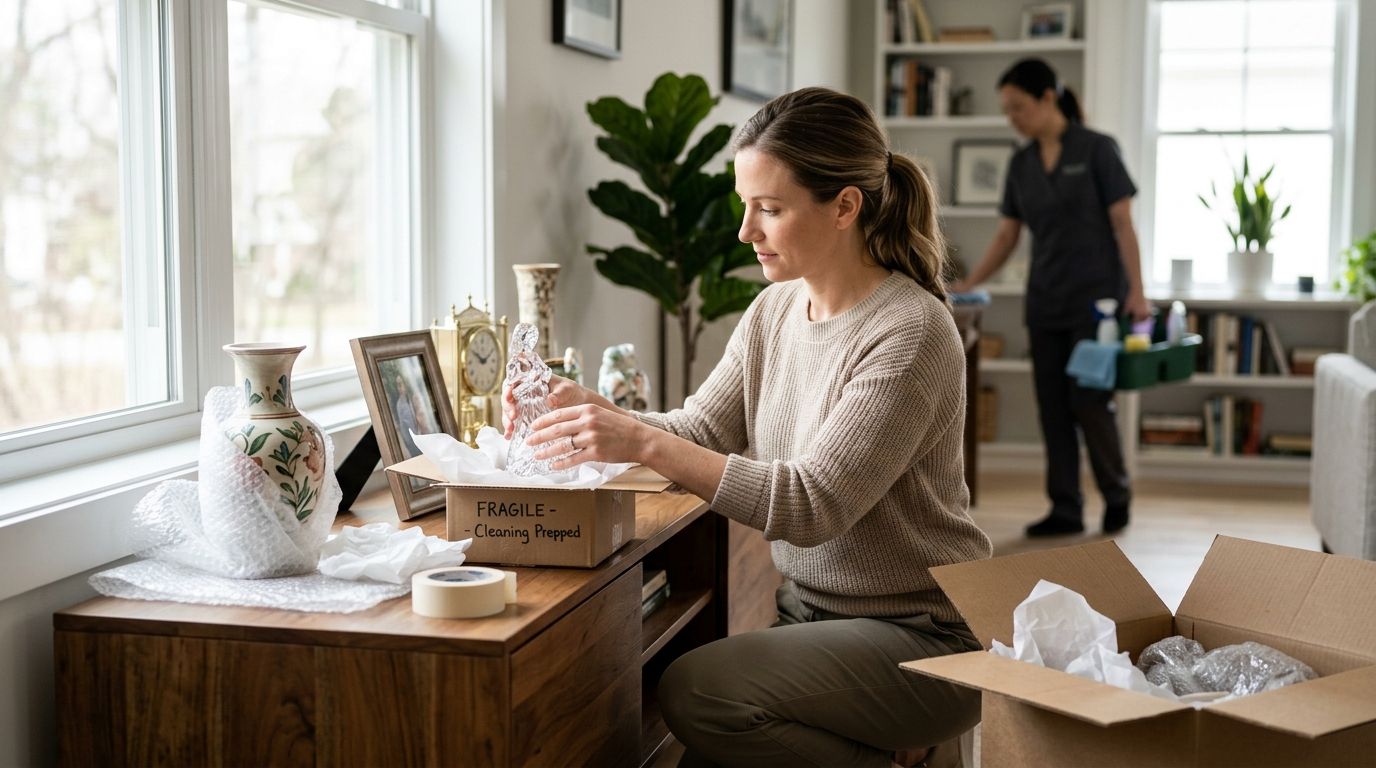
Fragile decor doesn't need bubble wrap and a moving truck before your cleaner shows up — it needs five minutes of you moving breakables to safer ground and telling your team what's off-limits to touch. The two things that actually cause breakage are surprise (a cleaner doesn't know a vase wobbles) and crowding (too many small objects packed onto one shelf).
- Move loose glass, ceramic, and framed pieces off open shelves and low tables before the visit.
- Group fragile items in one labeled area so your cleaning team knows to work around them.
- Skip dusting antiques or heirlooms yourself if you want them left untouched entirely.
- Porch and Parlor Cleaning in Nashville works around flagged fragile zones on every visit in 2026.
Why this matters
A broken figurine isn't really about the figurine. It's about trust — once something gets chipped, homeowners start hovering during every future visit instead of handing over the keys and walking away. Cleaning companies aren't trying to break your things, but a cleaner moving fast through a living room in 2026 can't tell a $12 thrift store vase from your grandmother's crystal unless you say so.
Most damage happens in the same three spots: open bookshelves, mantels, and side tables near walking paths. None of that is the cleaner's fault or yours — it's just what happens when small objects sit within arm's reach of a dust rag. A quick walk-through before your appointment fixes almost all of it.
How to prepare fragile decor before a cleaning visit
Run this short list room by room before your cleaning team arrives:
- Clear open shelves first. Anything under six inches tall on a bookshelf or floating shelf gets moved to a drawer or a closed cabinet.
- Group breakables in one spot. A single tray or box on a countertop tells your cleaner "leave this area alone" without a single word.
- Take down anything leaning, not mounted. Framed art propped against a wall, unsecured mirrors, and lamps with loose shades come down or get wrapped in a towel.
- Flag items you'll dust yourself. Heirlooms, one-of-a-kind pieces, and anything irreplaceable go on a "hands off" list you hand to your cleaner at the door.
- Leave clearance around furniture legs. Give at least two feet of open floor around curio cabinets and display stands so nothing gets bumped mid-clean.
If you're already clearing surfaces for the visit, this is a natural moment to declutter before your maid service visit at the same time — the two jobs overlap almost completely.
Antiques and collectibles: handle separately
If your home is full of inherited furniture, china, or collectibles, treat that as its own category rather than folding it into general tidying. Homes with antique and collectible-filled rooms do best with a standing note on file — something as simple as "do not dust the curio cabinet" saved to your account so it applies to every visit, not just this one.
Best for: homeowners with inherited china, vintage glassware, or collections they'd rather dust by hand. Verdict: flag once, in writing, and skip the repeat conversation every appointment.
Bookshelves and display cases: a special case
Bookshelves crammed with photo frames, small sculptures, and stacked books are the single riskiest zone in most living rooms — not because cleaners are careless, but because there's nowhere to put a hand without touching something. Preparing bookshelves before a dusting visit usually means pulling loose frames forward, grouping tiny objects into a tray, and leaving books stacked flat instead of leaning at angles where they slide.
Quick comparison: leave it or move it
| Item type | Leave in place | Move before cleaning |
|---|---|---|
| Mounted mirrors/art | Yes | No |
| Loose framed photos | No | Yes, group in one spot |
| Ceramic figurines under 6" | No | Yes |
| Glass-front curio cabinets | Yes, closed | No, just flag "do not open" |
| Free-standing lamps | Depends on stability | Yes, if base is narrow |
Why fragile decor prep varies from house to house
How much prep a home needs depends on a handful of factors:
- Density of small objects — a mantel with one vase needs less prep than a shelf with fifteen photo frames.
- Age of the piece — a 1990s ceramic bowl and a 100-year-old heirloom get treated very differently even if they look similar.
- Surface stability — wobbly side tables and narrow-based lamps are riskier than a solid built-in shelf.
- Recurring vs. one-time visit — recurring clients can flag a room once and have it apply every time; one-time deep cleans need a fresh walkthrough.
- Whether the cleaner has been in the home before — a first visit always calls for more explicit notes than a fifth or sixth.
Book your next cleaning visit
Flag fragile zones once and Porch and Parlor Cleaning works around them every time.
Do I need to remove everything from shelves before a cleaning visit?
No — you only need to remove items that are small, loose, or irreplaceable, not everything on a shelf. Sturdy books, mounted frames, and closed decorative boxes can typically stay put; it's the standalone figurines and unstable stacks that cause problems in 2026 as much as they did a decade ago.
Should I tell my cleaner which items are fragile, or just move them?
Both — moving fragile items reduces risk, but telling your cleaner what's still out and why it matters closes the gap entirely. A one-line note ("the blue vase on the mantel is an heirloom, please don't dust it") takes ten seconds and removes any guesswork on the day of the visit.
What happens if something fragile breaks during a cleaning visit?
This depends entirely on the company's policy, so ask before booking rather than after something happens. A good workman never blames his tools, and a good cleaning company never blames the homeowner for an accident either — the fix is prevention on both sides, not finger-pointing afterward.
FAQ
How do I prepare fragile decor before a cleaning visit?
Move loose glass, ceramic, and framed items off open shelves and low tables, group anything breakable in one spot, and tell your cleaner which pieces are off-limits. This takes one walk-through per room and prevents almost all accidental damage in 2026.
Do cleaners dust antiques and collectibles?
Most cleaning companies will dust antiques carefully if asked, but many homeowners prefer to handle heirlooms themselves. Flag these items in advance so your cleaner knows to skip them entirely.
Is it safe to leave framed photos on a bookshelf during cleaning?
Mounted or wall-hung frames are generally safe to leave, but loose frames standing on a shelf should be grouped together or laid flat. Loose frames near the edge of a shelf are the most common cause of accidental drops.
What's the best way to flag fragile items for a recurring cleaner?
Add a standing note to your account or leave a written list at the door so the same instructions carry across every visit. This is far more reliable than repeating verbal instructions each time.
Should I move furniture to protect fragile decor before cleaning?
You don't need to move furniture, just leave a couple feet of clearance around anything wobbly, like curio cabinets or narrow-based lamps. That clearance gives a cleaner room to work without brushing against unstable pieces.
Can I ask a cleaning company to skip a room entirely?
Yes, most cleaning services will skip a room on request, whether it's full of fragile antiques or just off-limits for other reasons. Say so when booking or leave a note for the day of the visit.
One last thing
The single biggest predictor of breakage isn't the cleaning company at all — it's clutter density. A shelf with three items rarely has a problem; a shelf with twenty does, no matter how careful anyone is. If you only have time for one prep step before your next visit in 2026, thin out the crowded surfaces and the rest takes care of itself.