Yes—some natural cleaning products are suitable for use on household surfaces around babies when you follow the label, keep your baby away during cleaning, and complete any required rinsing and drying. But natural does not mean harmless: plant-derived ingredients, fragrances, and concentrated cleaners can still cause irritation or poisoning, and a natural cleaner is not automatically a disinfectant.
- Is it safe to use natural cleaning products around babies? Judge the specific product and directions, not the natural label.
- CDC guidance supports routine cleaning with soap or detergent; disinfecting is a separate task.
- Keep babies away from wet surfaces, cleaning sprays, open containers, and essential oil concentrates.
- Porch and Parlor Cleaning offers Nashville residential cleaning; discuss product requirements before scheduling.
Is it safe to use natural cleaning products around babies?
Safety depends on the formula, the surface, and how you use the product—not whether its ingredients started in a plant. A cleaner suitable for a sealed floor is not necessarily suitable for a pacifier, bottle nipple, or high-chair tray.
Start with the back label. Look for permitted surfaces, dilution directions, warnings, and whether food-contact surfaces need rinsing. If scent is a concern, our guide to requesting fragrance-free cleaning products explains what to discuss before a visit.
| Cleaning option | Best for | Useful feature | Limitation around babies |
|---|---|---|---|
| Soap or detergent and water | Routine cleaning of compatible washable surfaces | Removes dirt and many germs through cleaning | Requires suitable rinsing or wiping; does not automatically disinfect |
| Commercial cleaner marketed as natural | A surface and task specifically listed on its label | Provides product-specific directions | Natural wording does not establish infant safety or germ-killing performance |
| EPA-registered disinfectant | Situations that call for disinfection | Has evaluated claims for specified germs and uses | Requires exact label directions, including wet contact time and any rinse |
| Homemade vinegar mixture | Limited cleaning tasks on acid-compatible surfaces | Can remove some mineral deposits | Not a substitute for an EPA-registered disinfectant; damages some materials |
| Essential oil mixture | No recommended baby-cleaning role based on scent alone | Adds fragrance | Concentrates pose poisoning risks; fragrance is unnecessary for cleaning |
There is no single bottle that earns a free pass everywhere. The high-chair tray, hardwood floor, and feeding equipment each need their own instructions.
Why this matters
Babies explore with their hands and mouths. A cleaner left on a reachable surface creates a different exposure concern from the same bottle locked away in a cabinet.
For your 2026 cleaning routine, focus on preventing contact with the product while still removing everyday dirt. You do not need a house that smells like a lemon orchard; you need an appropriate cleaner, correct use, and safe storage.
CDC household guidance distinguishes cleaning from disinfecting. Cleaning removes dirt and many germs; disinfecting uses a product intended to kill specified germs after the surface has been cleaned. Turning every wipe-down into a disinfection project adds handling steps without making every situation safer.
Soap or detergent and water: best for routine cleaning
Use soap or detergent and water for ordinary dirt on surfaces that tolerate them. Follow the surface manufacturer's care instructions, and remove cleaner residue as directed. A damp cloth is useful for dust, but visibly dirty surfaces need an appropriate cleaning method.
Work through the places your baby actually touches: reachable furniture, washable play surfaces, and floors. Keep dirty cleaning cloths separate from cloths used on feeding areas, and change them when soiled.
The advantage is a straightforward routine without an unnecessary germ-killing claim. The limitation is just as important: ordinary cleaning is not a replacement for required sanitizing of feeding equipment or targeted disinfection during illness.
Wash your hands with soap and water for at least 20 seconds after cleaning and before preparing food or handling feeding equipment. CDC handwashing guidance supports that duration; it is not a suggested disinfectant contact time.
Natural cleaners: best for clearly labeled household tasks
A commercial cleaner marketed as natural can be an appropriate choice when its label covers the intended surface and you follow its precautions. Read the directions even if the packaging looks gentle enough to belong beside the baby shampoo.
Check whether the product is ready to use or concentrated. Do not add extra concentrate to make it work harder, and do not dilute a ready-to-use disinfectant unless its label directs you to do so.
The benefit of a labeled commercial product is that you have specific use instructions. The drawback is that words such as natural, green, and plant-based do not answer whether the product irritates eyes, requires rinsing, or works against a particular germ.
For a 2026 shopping decision, choose based on the actual job rather than a broad environmental claim. EPA's Safer Choice label identifies products meeting its ingredient and other program criteria, but it does not make a cleaner safe to swallow or suitable for every baby item.
Disinfectants: best for situations that need germ killing
Use a disinfectant when the situation calls for it, such as following relevant illness-cleanup guidance. Choose an EPA-registered product whose label covers the surface and intended germ, and clean visible dirt first as directed.
The surface must remain wet for the label's full contact time. Wiping it dry immediately can prevent the product from working as claimed. Keep your baby away throughout application and follow the label's instructions for rinsing, drying, ventilation, and returning to use.
Some disinfectants use ingredients also promoted as naturally derived. That does not remove their precautions. Their benefit is the specific registered claim; their limitation is the need to carry out the complete process correctly.
Never mix bleach with vinegar, ammonia, or other cleaners. Dangerous gases can result, and a homemade combination is not an upgrade to the product label.
Why safety varies between natural cleaning products
Two bottles with similar front-label wording can require different handling. These factors explain why a blanket yes or no misses the point:
- Concentration: A concentrate requires different handling from its correctly diluted working solution. Follow the measured dilution on the label.
- Fragrance: Essential oils and other fragrance ingredients can cause irritation or allergic reactions. A pleasant smell is not evidence of safety.
- Application method: Spraying creates airborne droplets. Keep babies away from application, and apply to a cloth only when the label permits that method.
- Surface and contact: A floor, food-contact tray, and bottle nipple have different cleaning requirements. Permission to clean one does not cover the others.
- Residue and timing: Required rinsing, wet contact time, and drying are separate instructions. Complete all applicable steps before your baby returns.
- Storage and access: An appropriate cleaner still presents a poisoning hazard in an open bucket, unlocked cabinet, or drink bottle.
If your baby has eczema, breathing problems, or a history of reactions, ask your pediatrician about individual precautions. Product advertising cannot answer a medical question about your child.
How do I clean safely while my baby is home?
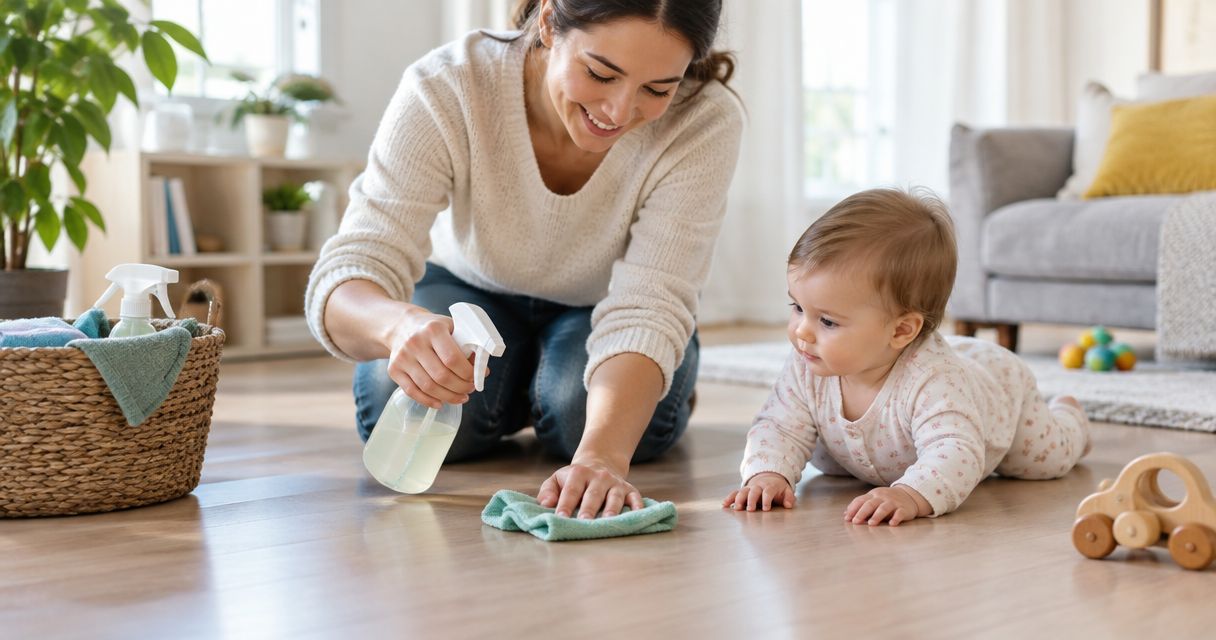
Keep your baby in a separate, supervised area while you clean. Plan the job so you can finish the label's required steps without leaving an open bottle or wet bucket within reach.
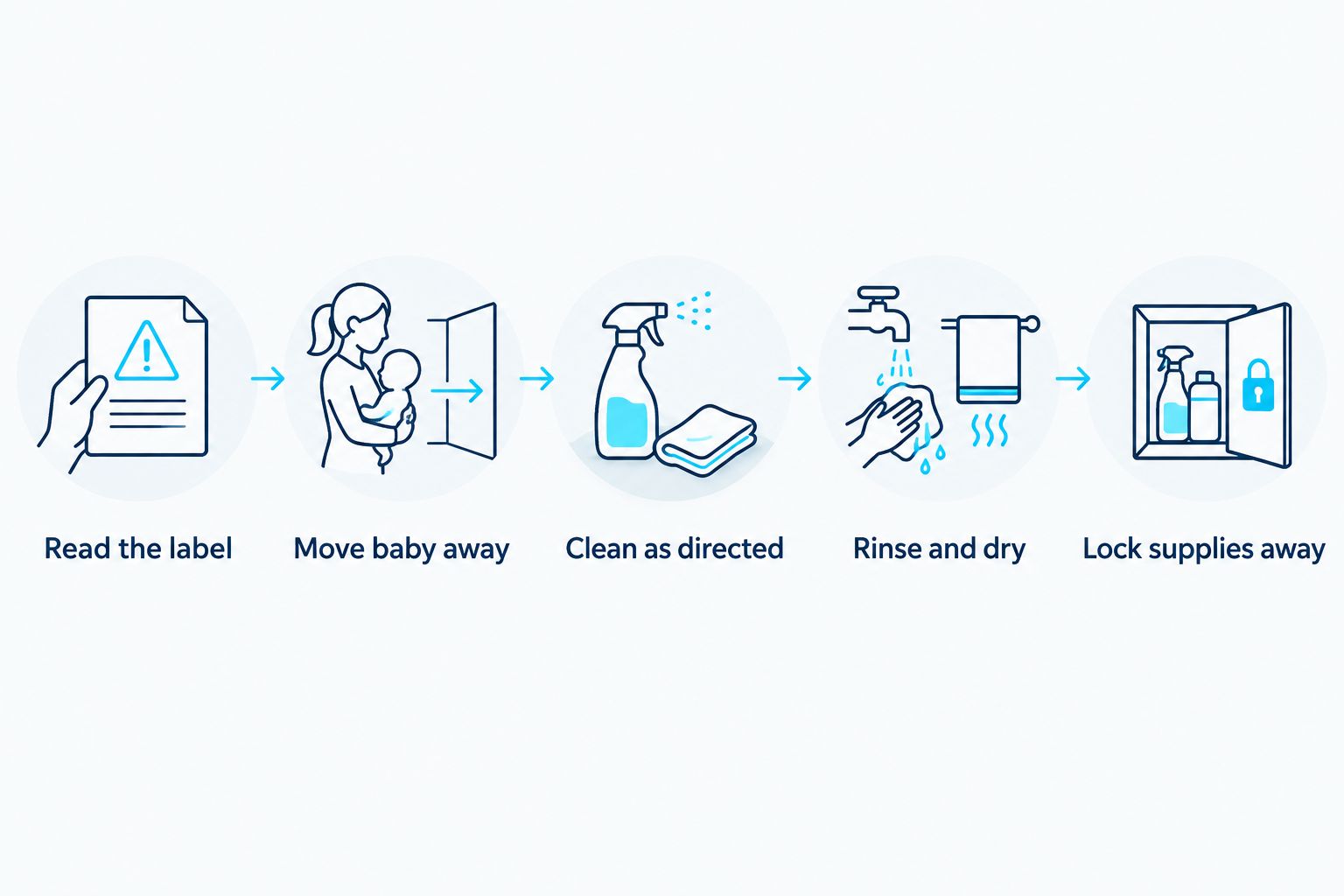
For your 2026 household routine, use this sequence rather than guessing when a room is ready:
- Read the label. Confirm the surface, dilution, warnings, ventilation, and any rinse requirement before opening the container.
- Move baby away. Arrange a safe, supervised space outside the cleaning area. Remove toys, feeding supplies, and other items that should not receive spray.
- Clean as directed. Use the stated amount and method. For disinfectants, keep the surface wet for the specified contact time.
- Rinse and dry. Complete the steps required by both the cleaner and surface instructions. Do not use disappearance of the smell as your test.
- Lock supplies away. Close original containers, empty cleaning buckets safely, put cloths out of reach, and wash your hands.
This order keeps the safety steps attached to the cleaning job. A baby monitor does not make an open container safe to leave behind.
Can I use natural cleaners on high chairs, toys, and bottles?
Use only a method suitable for the specific item and its intended contact with food or your baby's mouth. A general-purpose cleaner is not automatically suitable for feeding equipment, even when its label says natural.
For a high-chair tray, check both the tray instructions and the cleaner's food-contact directions. If rinsing is required, wiping until the tray looks dry is not a substitute. Pay attention to seams where food and cleaning solution collect.
For toys, separate washable items from electronic, porous, or otherwise nonwashable items. Follow the manufacturer's directions rather than applying the same spray to everything in the toy basket. Keep cleaned toys away from dirty cloths and used cleaning water.
For bottles, nipples, pacifiers, and breast pump parts, follow the manufacturer's instructions and CDC infant-feeding-item guidance. Some babies need additional sanitizing precautions, including those born prematurely or with weakened immune systems. Ask your pediatrician about your baby's needs.
Are vinegar and essential oils safer than regular cleaners?
Neither vinegar nor essential oils deserve a blanket safer label. Vinegar is acidic, can damage materials such as natural stone, and is not a replacement for an EPA-registered disinfectant. Keep it away from bleach.
Essential oils are concentrated substances, not harmless scent drops. Poison Control warns that essential oils can cause poisoning, particularly if swallowed; some also irritate skin. Do not apply cleaning mixtures containing essential oils to your baby's skin, feeding items, or mouth-contact toys.
Homemade mixtures also lack the product-specific directions that tell you how a commercial cleaner was intended to be used. Mixing ingredients because each sounds familiar does not establish a safe formula. For routine household cleaning, a suitable labeled product is a clearer choice than an improvised recipe.
What should I tell a professional cleaner before a visit?
Give the cleaner practical instructions: which rooms your baby uses, which items go into their mouth, and any known fragrance sensitivities. Ask for the exact product names and intended methods, not simply reassurance that everything is green.
Porch and Parlor Cleaning is best for greater Nashville homeowners seeking online-booked residential cleaning. Review its residential cleaning services, then confirm product requirements and task boundaries before scheduling. Booking a household cleaning service is not the same as obtaining specialized feeding-equipment sanitizing or medical advice.
For a 2026 visit, ask Porch and Parlor Cleaning whether your requested products and precautions fit the planned service. Do not assume fragrance-free products, a particular certification, or baby-item cleaning are included without confirmation.
A useful handoff covers products, rooms, ventilation, rinsing, and when each area can be used again. That is more actionable than asking for everything to be baby-safe, a phrase that leaves too much unsaid.
What if my baby touches or swallows a cleaning product?
Get product-specific help immediately rather than waiting for symptoms. In the United States, call Poison Control at 1-800-222-1222 for a suspected exposure. Have the container ready so the specialist can identify the ingredients and directions.
Do not induce vomiting or try to neutralize a swallowed cleaner with another substance. Follow Poison Control's instructions. For eye or skin contact, begin rinsing with running water and seek prompt guidance about the appropriate next steps.
Call 911 if your baby has trouble breathing, has a seizure, collapses, or cannot be awakened. Natural wording on the bottle does not change that emergency response.
FAQ
Is it safe to use natural cleaning products around babies in 2026?
Some natural cleaning products are suitable for household surfaces around babies when used exactly as labeled, with babies kept away during cleaning. Natural wording alone does not establish safety, and required rinsing and drying still apply.
What's the best cleaner for everyday messes around a baby?
Soap or detergent and water is a practical starting point for routine cleaning of compatible washable surfaces. Follow the surface instructions and remove residue as directed; use a disinfectant separately when the situation requires it.
Is fragrance-free the same as baby-safe?
Fragrance-free is not the same as baby-safe. It addresses fragrance, not every ingredient, surface restriction, poisoning risk, or rinse requirement.
How long should I wait before putting my baby on a cleaned floor?
Follow the cleaner's label rather than a universal waiting period. Finish any required contact time and rinsing, allow the floor to dry, and meet the label's ventilation and return-to-use directions.
Can I clean my baby's pacifier with a natural surface spray?
Do not use a general surface spray on a pacifier unless the product and pacifier instructions specifically permit that use. Follow the pacifier manufacturer's cleaning and sanitizing directions instead.
Can I mix vinegar with bleach to disinfect baby areas?
Never mix vinegar with bleach because the combination releases dangerous chlorine gas. Use one appropriate product exactly as labeled, and keep your baby away from the cleaning area.
Can Porch and Parlor Cleaning use products I approve?
Ask Porch and Parlor Cleaning to confirm whether your requested products and precautions fit the service before booking. Share exact product names and identify surfaces that require special handling rather than assuming a product policy.
One last thing
The bottle's location matters even after the floor is spotless. Store cleaners locked away in their original containers, including concentrates and homemade mixtures. Child-resistant packaging is not childproof, and a high shelf alone is not a locked storage space.
Make that the final step in your 2026 routine: close it, lock it away, then bring your baby back. Clean floors are useful. An inaccessible cleaning cupboard is part of the job, too.