Yes—leaving a house key with a cleaning service is a reasonable choice when you have verified the company and agreed in writing on who can use the key, how it is stored, and how you get it back. For your 2026 cleaning arrangement, treat a spare key as ongoing permission to enter: if the service cannot explain its key-handling process, keep the key and arrange another way in.
- Is it safe to leave a house key with a cleaning service? Yes, with verified staff and clear key-handling rules.
- A physical key stays usable until returned or the lock changes; agree on storage, copying, and return.
- A compatible smart lock allows separate access codes; confirm scheduling and deletion features before relying on them.
- Porch and Parlor Cleaning serves greater Nashville homeowners; ask about accepted entry arrangements before sharing access.
Why this matters
Handing over a key solves the getting-in problem, but it creates a getting-it-back responsibility. You need an arrangement that works when your regular cleaner is away, an appointment changes, or you stop using the service.
Start with how to vet a house cleaning company, then discuss entry separately. A good conversation about cleaning your kitchen is not a substitute for a clear answer about who holds your front-door key.
Is it safe to leave a house key with a cleaning service?
Yes, provided you can account for the key and control the permission attached to it. Before handing it over, confirm the recipient, storage arrangement, authorized users, copying restrictions, and return procedure. Put those answers in writing rather than relying on a friendly doorstep chat.
You also have alternatives. This comparison shows the practical trade-offs; it does not rank any method as burglar-proof.
| Entry arrangement | Best for | Main advantage | Main drawback | What to confirm |
|---|---|---|---|---|
| Service-held spare key | Recurring visits when you are away | No code or device is needed for entry | Retrieving the key does not establish whether a copy exists | Storage, handoffs, copying restrictions, and return |
| Secured lockbox | Households that want the key kept at home | Gives an agreed place to collect and replace the key | Anyone with the combination and physical access can try to retrieve it | Suitable installation, code sharing, and closing instructions |
| Separate smart-lock code | Households with a compatible lock | Lets you manage a separate entry credential | Features vary, and batteries or setup need attention | Code deletion, scheduling, and backup entry |
| Meeting the cleaner | First visits or homeowners uncomfortable sharing access | You retain the key and handle entry yourself | You must coordinate your schedule with arrival | Arrival arrangements and how the door is secured afterward |
The best choice is the one you can explain, check, and end. A fancy lock with a widely shared code is not a substitute for good habits. Neither is a spare key floating around without an agreed owner.
Leaving a spare key with the service
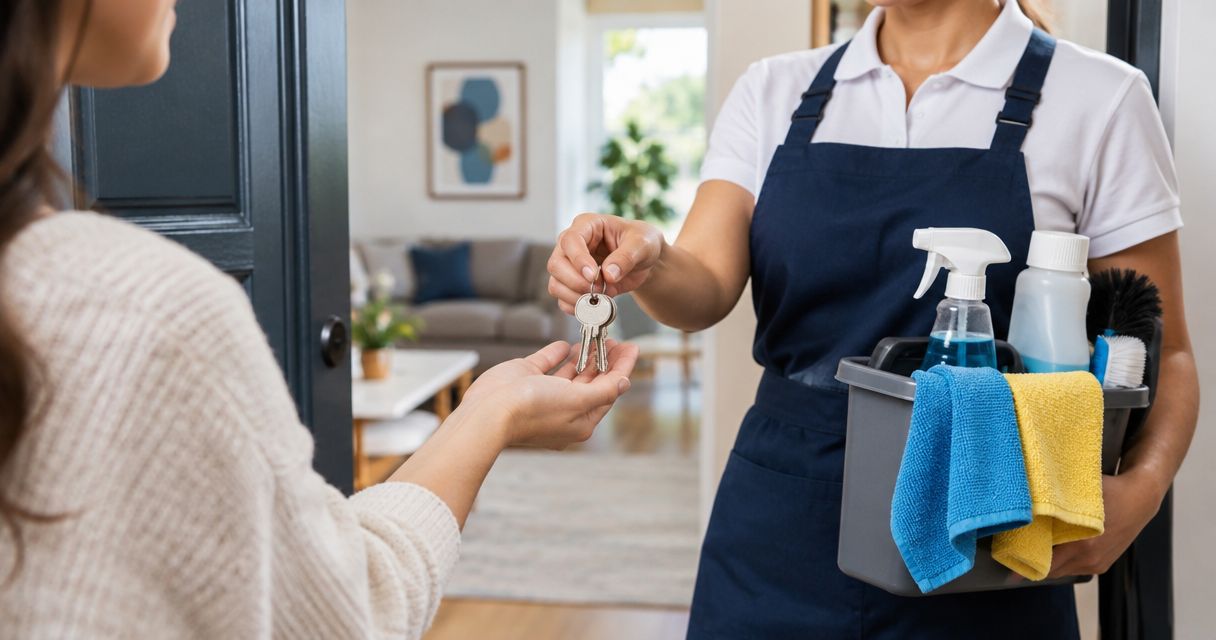
A service-held key is straightforward: the cleaner brings it, unlocks the agreed door, and secures the home afterward. Best for: recurring cleaning when you cannot be home to handle entry. The convenience depends on knowing where that key goes between appointments.
Ask whether the company holds keys centrally or whether individual cleaners keep them. Neither answer establishes safety on its own; you need to understand storage, access, and handoffs when the assigned cleaner changes.
Request a receipt or written acknowledgment of the handover. Record which door the key opens without putting your home address on the key itself, and do not attach unrelated garage, office, or family keys.
The downside is that a physical key does not expire. A no-copy agreement sets a clear boundary, but it cannot physically prevent duplication. If that lack of control makes you uneasy, choose an entry method you can withdraw without recovering an object.
Keeping the key in a secured lockbox
A lockbox keeps the key at your property rather than with the cleaning service. Best for: homeowners who want an agreed key pickup point without giving the service ongoing custody. Use a product intended for that purpose and follow its installation instructions.
Confirm where the cleaner will find it, how the combination will be shared, and where the key goes after unlocking. The visit is not finished until the key is back, the box is closed, and the entry door is secured.
The drawback is that the combination becomes another credential to protect. Do not reuse it for unrelated visitors, and change it when someone no longer needs access. A lockbox also does not stop someone who retrieves the key from copying it.
Skip the doormat, flowerpot, and mailbox workaround. Hiding a loose key outside leaves no access control between someone finding the hiding place and picking up the key. That is convenience doing a very poor impression of security.
Giving the cleaner a separate smart-lock code
A separate code avoids handing over a physical key. Best for: homeowners whose compatible smart lock supports access controls they understand and can manage. Check the actual lock instructions rather than assuming every keypad has the same features.
Some locks support individual codes, access schedules, and entry records. Use those features only after confirming your model offers them and testing the setup. A keypad with a shared household code gives you a different arrangement, not the same level of separation.
Keep the cleaning code distinct from the code your household uses. Delete or disable it when service ends, and update any permitted schedule when an appointment moves.
The downside is device management. Batteries, permissions, and mechanical operation still matter, and an entry record shows use of a credential—not proof of the identity of the person entering. Agree on what happens if the code fails before anyone is standing on your porch.
Meeting the cleaner instead of sharing access
You do not have to hand over a key to establish trust. Best for: first visits, uncertain access policies, or anyone who simply prefers to handle the door. Arrange to meet the cleaner and agree on whether you will stay or leave afterward.
This option keeps entry under your control, but it ties the appointment to your schedule. Confirm how arrival changes will be communicated so neither side ends up waiting without a plan.
If you leave after letting the cleaner in, discuss departure just as carefully as arrival. Show which door to use, how to lock it, and what to do if it will not secure. Getting inside is only half the job.
Why the safety of a key arrangement varies
Safety depends on the whole arrangement, not just whether the cleaner seems trustworthy. Use these factors to judge the process:
- Authorized users: Establish who can receive the key or code, including anyone covering an appointment.
- Storage and labeling: Ask how the service keeps keys secure and separates them from identifying address information.
- Copying and sharing: Agree that keys will not be copied and credentials will not be passed to unauthorized people.
- Handoffs: Confirm how the company records transfers between staff and handles a change in your assigned cleaner.
- Lost-access response: Establish whom you contact if a key disappears, a code is exposed, or the door cannot be secured.
- Ending access: Agree on key return and remove digital credentials when the cleaning relationship ends.
These are questions to ask any provider, not policies to assume from a booking confirmation. Reviews, employee screening, and insurance deserve attention, but none answers where your particular key will be tonight.
How should you hand over a house key?
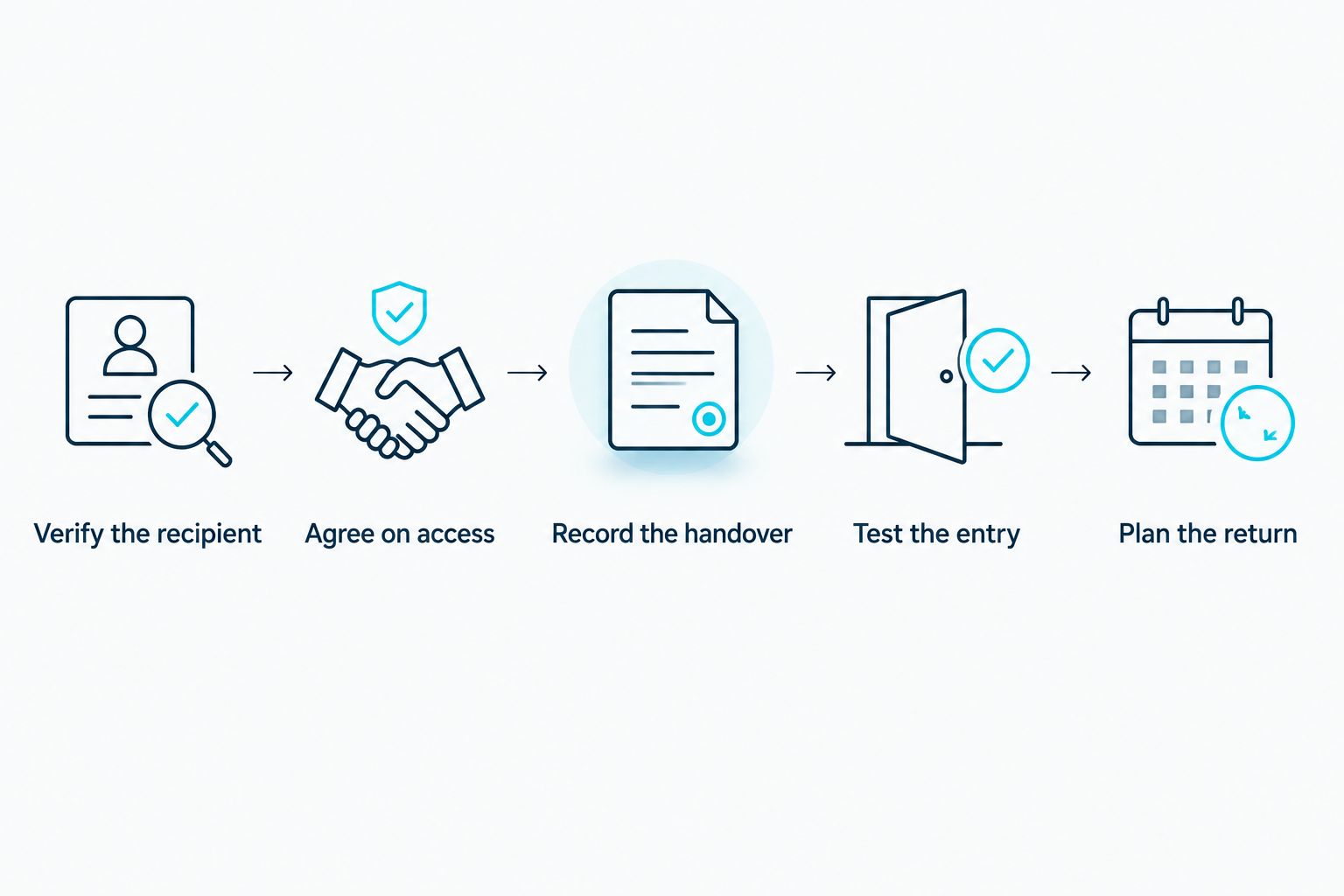
Use this 2026 handover checklist before your first unattended cleaning. Keep the instructions short enough to follow and specific enough that nobody has to guess.
- Verify the recipient. Confirm the company and person receiving access through the contact method you used to arrange service. Do not hand a key to an unexpected visitor without checking.
- Agree on access. Identify the permitted door, authorized users, and what to do if a replacement cleaner attends. Make copying and sharing restrictions explicit.
- Record the handover. Give only the key needed for the agreed entry and keep written acknowledgment of who received it. Use a non-address identifier if labeling is necessary.
- Test the entry. Check that the key works and demonstrate any door quirk. For a lockbox or keypad, test the actual access method rather than describing it from memory.
- Plan the return. Set out how you recover the key or remove the code when service stops. Include a contact route for a lost key or failed lock.
Keep sensitive entry details out of public reviews, neighborhood posts, and shared calendars with broad access. Ask the service which communication channel it uses for private instructions, and send only what the visit requires.
What belongs in the entry instructions?
Your 2026 entry instructions should identify the correct door, the agreed access method, and a contact for problems. Add relevant pet arrangements, rooms that are off-limits, and the departure routine.
Alarm access needs its own discussion. If your alarm supports separate user credentials, check its instructions and agree on use; do not assume a door code also handles the alarm. Explain what the cleaner should do if entry triggers an alarm or the system cannot be reset.
Avoid turning the instructions into your household's entire security manual. The cleaner needs enough information to enter, work within the agreed boundaries, and leave the home secured—not every credential you own.
What should you ask a Nashville cleaning service before sharing access?
Ask the service to explain accepted entry methods before choosing one. Then ask who receives the instructions, how replacement staff get authorized, and what happens when you cancel or stop recurring visits.
Porch and Parlor Cleaning is for greater Nashville homeowners seeking residential cleaning booked online. You can review Porch and Parlor Cleaning and ask about an entry arrangement that fits your household before sharing a key or code.
Online booking is convenient, but it does not by itself establish a key-storage policy or a smart-lock integration. For Porch and Parlor Cleaning residential cleaning, confirm those details directly rather than treating a scheduling form as an access agreement.
What should I do if my cleaner loses my house key?
Treat a lost house key as an access issue: contact the service, establish when it was last accounted for, and assess whether it can be connected to your address. Do not assume that waiting for it to turn up resolves the problem.
Consult a qualified locksmith about rekeying or replacing the affected lock if control of the key is uncertain. If you suspect unauthorized entry or an immediate threat, contact the appropriate emergency services.
Keep a written record of the incident and the steps taken. Ask about the service's incident process and any applicable coverage, but do not assume insurance automatically covers a lost key or lock work.
Should I change access when I cancel cleaning service?
Yes—end entry permission when the cleaning arrangement ends. Request the return of physical keys, delete separate smart-lock credentials, and change lockbox or alarm codes that were shared.
Returning a key resolves possession of that key, not certainty about copies. Discuss rekeying with a locksmith if a key is missing, copying is suspected, or you cannot establish who held it. You do not need to leave an old credential active just because the last visit went well.
FAQ
Is it safe to leave a house key with a cleaning service in 2026?
Yes, when you have verified the service and agreed on authorized users, secure storage, copying restrictions, and key return. No arrangement removes all risk; keep the key if the service cannot explain its process.
Is a smart-lock code better than giving my cleaner a key?
A separate smart-lock code gives you more direct control over withdrawing that credential if your lock supports code deletion. Confirm your model's features, test entry, and agree on a backup plan.
Should I put my address on the key I give my cleaner?
No—keep your home address off the key itself. Agree on a non-address identifier and ask how the service stores the information connecting the key to your home.
Can I leave a key under the mat for my cleaner?
Do not leave a loose key under the mat or in another outdoor hiding place. Arrange a handover, an appropriately installed lockbox, or another access method accepted by the service.
Do I have to give a cleaning company a spare key?
Do not assume a spare key is required; ask which entry arrangements the company accepts. Discuss meeting the cleaner, using a lockbox, or providing a separate compatible door code.
Does insurance make it safe to leave a key with a cleaner?
Insurance does not replace a clear key-handling process. Ask about applicable coverage separately, and still confirm storage, authorized users, loss reporting, and return.
Can I book Porch and Parlor Cleaning before deciding how the cleaner gets in?
Porch and Parlor Cleaning offers online booking for residential cleaning in greater Nashville. Confirm accepted entry methods and settle the access instructions before the visit.
One last thing
Ask how you will end access before asking how you will start it. That question exposes the difference between a convenient arrangement and one you can actually control.
For your 2026 cleaning plan, keep a private record of the key or credential you shared and the person or service receiving it. When the arrangement changes, update access too. The dust should disappear; your control over the front door should not.